
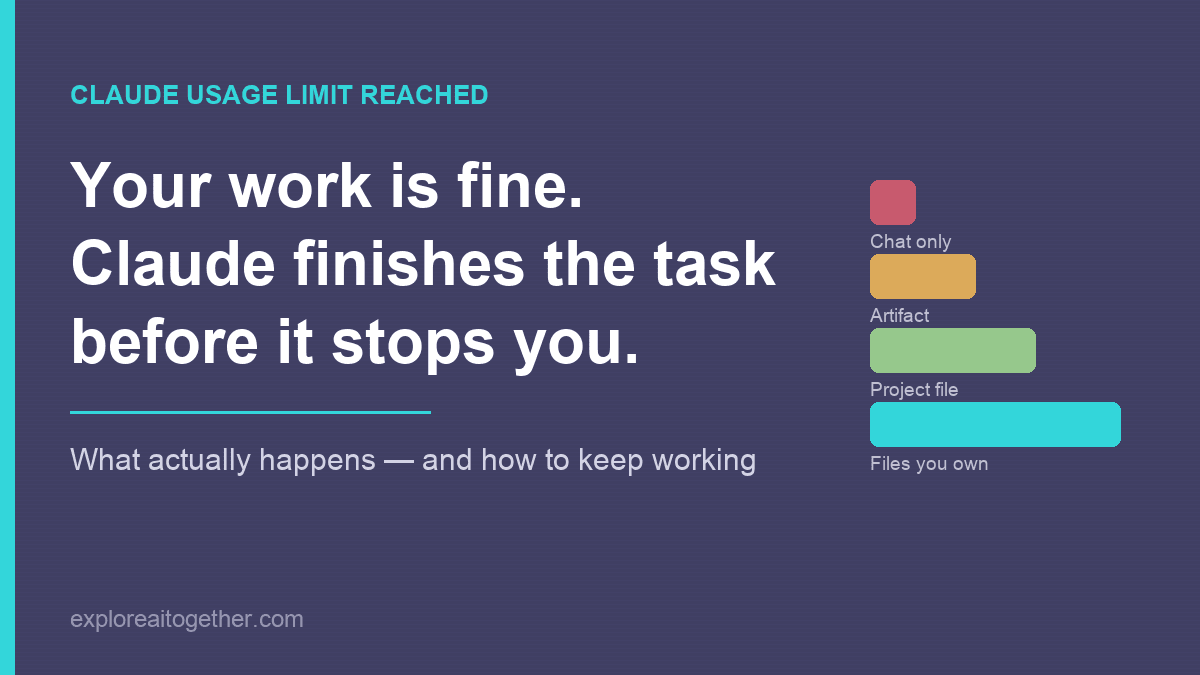
You were in the middle of something good. Now there’s a message telling you you’ve reached your usage limit and a time when you can come back.
Your work is almost certainly fine. Claude generally finishes the task it’s working on before it stops you — you’re not looking at a half-written file or an abandoned build. What you lost is momentum, which is genuinely annoying and much easier to fix than what you’re probably imagining right now.
Here’s what actually happened, what to do in the next five minutes, and the one change that makes the next time a non-event.
What actually just happened
Three things worth knowing, because most of what’s written about this gets at least one of them wrong.
You hit a usage limit, which is not the same as a length limit. A usage limit means you’ve used your allowance of messages for now. A length limit means one conversation has grown too large for the model’s context window — that’s the “prompt is too long” error, and it has a completely different fix. If Claude told you about a reset time, you’re in the first case.
Every Claude app draws from the same pool. Claude on the web, the desktop app, mobile, and Claude Code all count against one allowance. This catches people out constantly. A heavy morning in Claude Code will absolutely shorten your afternoon in the browser, and there’s no separate bucket for the terminal.
There are two limits running at once. A session limit on a rolling five-hour window, which every plan has, and — on paid plans — a weekly limit on top. The five-hour window rolls continuously. The weekly limit resets at a fixed time assigned to your account.
One more thing nobody mentions: you can just look at this. On Pro, Max, Team, and seat-based Enterprise plans, go to Settings → Usage. You’ll see progress bars for both your session and weekly limits, how much time is left in the current session, and when the weekly limit resets. It’s the difference between guessing and knowing, and it takes about ten seconds.
What you won’t find anywhere is a number. Anthropic doesn’t publish “you get X messages on Pro,” because the real answer depends on how long your messages are, how big your attachments are, how long the conversation has grown, and which model and features you’re using. Every specific figure you’ve read in a blog post is somebody’s estimate. Treat them that way — and if you want the actual shape of what each plan gives you, I keep a full comparison of usage limits across ChatGPT, Claude, Gemini, Grok and Perplexity updated monthly.
What to do in the next five minutes
If you’re in a chat conversation — the honest answer is that you wait, and it costs you less than you think. When the limit resets, open the same conversation and tell Claude to continue. The conversation is still there, Claude can still read all of it, and it picks up from where it stopped. I do this regularly. It’s an interruption, not a loss.
If you’re in the middle of a multi-step task in Claude Code, spend a minute differently. Agentic work is where an interruption genuinely costs something: when a long task gets cut off partway through a plan, resuming can mean Claude re-reads the plan and misjudges what’s already done, which burns fresh allowance redoing finished work. If you still have a prompt or two left, ask Claude to write down what it completed, what’s in progress, and what comes next — into a file, not into the chat. When you come back, /resume reattaches you to the session and that file tells it exactly where things stood.
If you want the work out of Claude entirely while you wait, you can export the conversation — I’ve written a complete guide to exporting from Claude covering conversations and files.
What not to bother with. There’s a standard list of tips that circulates for this — start a fresh conversation, batch your questions, switch to a smaller model, turn off connectors and web search, spread your work across the day. They’re all technically true and they’ll buy you a bit of headroom. None of them addresses why a five-hour wait was able to stop you in the first place. That’s the part worth fixing.
Why this was only an inconvenience for me
I hit Claude’s limits more than any other tool’s, and it’s not because something’s wrong. Claude is where I do my writing and my hardest thinking, so it’s where I spend the most demanding hours. Meeting the ceiling is a side effect of using it for the thing it’s best at.
It stopped mattering when I changed three things.
Keep your knowledge in files you own
Everything this blog runs on lives in files. Ideas, research, drafts in progress, the publishing workflow, prompts, documentation. It’s the same setup I use for things that have nothing to do with writing — processing HSA receipts, tracking vehicle service records, keeping personal finance summaries.
This is what Projects were reaching for in the early days of AI, done properly. The knowledge doesn’t live inside an AI conversation. It lives in files that I own, and AI is just another interface for working with them.
A conversation is temporary. My files aren’t.
The practical effect is that when Claude stops, almost nothing about my situation changes. The work is on disk. Any model can read it. I lost my place, not my work.
If you want the reasoning behind structuring things this way, context engineering is the same idea applied to getting better output in the first place: decide what the model sees, and keep it somewhere you control.
Give different models different jobs
I run several models at once, and not as backups. Each one has a job.
| Model | What I use it for |
|---|---|
| Claude | Writing and deep thinking — the most demanding work, which is why it’s where I hit limits |
| ChatGPT | Where I spend the most overall time. Long-term memory and a general companion |
| Gemini | Research, shopping decisions, fact-checking, travel and hotel questions, sometimes image generation |
| Codex | Coding |
I’m not describing an emergency plan. I answered the interview questions behind this article by talking to ChatGPT while Claude was drafting it. That’s a normal working session for me, and it’s why “Claude is unavailable for four hours” isn’t a stoppage — ChatGPT was never the understudy, it was already doing its own job.
A useful side effect: because the work is naturally spread across tools, no single one absorbs all of it. I’ve never hit ChatGPT’s usage limits. Partly its allowances are generous, but mostly I was never asking it to do everything.
If you’re weighing up which coding tool to lean on, I’ve compared Codex and Claude Code directly.
Use a different model to review important work
The third piece, briefly, because it deserves its own article. When something matters, don’t ask the model that produced it to check it — it tends to agree with itself, since the blind spots that shaped the answer also shape the review. Take it to a different model instead.
What this actually costs
I pay for ChatGPT, Claude, and Gemini, at roughly $20 a month each. I do that because I write about AI and I want hands-on experience with all of them.
Most people should not do this. If you’re starting out, pick one — ChatGPT or Claude, whichever suits you — and pay for that. Add a second only when you have a specific reason, and you’ll know when you do. Three subscriptions is a professional expense for me, not a recommendation.
Upgrading your plan is a real answer in one situation: you’re repeatedly exhausting your weekly limit, not just the five-hour window. That’s a signal you’ve outgrown the tier. But if you’re hitting the session limit occasionally and getting on with something else, you’re using it correctly. That’s what the limit is for.
When this won’t work
You’ve exhausted the weekly limit. Everything above assumes a five-hour reset. A weekly limit resets at a fixed time assigned to your account, and nothing you do today shortens that. Check Settings → Usage to see which one you’ve hit — they’re different problems.
You had no allowance left to spend. If the limit landed with nothing in reserve, you can’t ask Claude to write a handoff note. Whatever files already exist are what you have, which is the argument for keeping state in files by default rather than as an emergency measure.
A file restores state, not reasoning. Notes tell a fresh session where things stood. They don’t reproduce the thread of thinking that got you there, and a genuinely complex conversation can come back slightly worse after a restart. Better than starting over. Not identical to never stopping.
Multiple accounts. People ask. I don’t cover it — it’s against the terms, and it treats an occasional pause as a problem worth engineering around rather than what it usually is, which is a signal about how you’ve structured your work.
What survives when the limit hits
The reason a limit is a non-event for some people and a disaster for others has almost nothing to do with the limit. It’s about where the work was sitting when the message appeared.
| Where your work lives | Survives the cutoff | The model can reload it itself | Cost to resume |
|---|---|---|---|
| Chat scrollback only | Visible, but not portable | No | Highest — re-explain everything |
| Artifact or canvas | Yes | No | High — you paste it back |
| Project file | Yes | Partly | Medium |
| Local file or repo | Yes | Yes | Low |
| Notes file with current state | Yes | Yes | Near zero — resume in one prompt |
Find your row. The top one is where most people keep work by default, and it’s the only row that makes a five-hour pause expensive.
Quick reference
Which wall did you hit?
| Usage limit | Length limit | |
|---|---|---|
| Message | “Usage limit reached,” with a reset time | “Prompt is too long” |
| Cause | Used your allowance for now | One conversation outgrew the context window |
| Fix | Wait for the reset, then continue | Start a new conversation |
What to do now
- Check Settings → Usage — session limit or weekly limit?
- In chat: wait for the reset, reopen the conversation, tell Claude to continue.
- In Claude Code mid-task: if you have a prompt left, have it write down what’s done and what’s next — to a file. Use
/resumewhen you return. - Get on with something else. That’s the intended behaviour.
So it doesn’t matter next time
- Keep your work in files you own, not in conversation history
- Give different models different jobs, so none of them is load-bearing
- For important work, have a different model review it
Common questions
Does Claude finish what it’s doing before the limit stops you?
Generally yes. In normal chat use Claude completes the response it’s working on and then tells you you’ve reached the limit. You’re not left with half a file. Long multi-step tasks in Claude Code are the exception — those can be interrupted partway through.
When does Claude’s usage limit reset?
Session limits run on a rolling five-hour window. Weekly limits, on paid plans, reset at a fixed time assigned to your account. Settings → Usage shows both, including how long is left in the current session.
Do Claude Code and Claude.ai share the same usage limit?
Yes. Claude on the web, desktop, mobile and Claude Code all draw from the same allowance. There’s no separate pool for the terminal.
Does Claude remember what it was working on after the limit resets?
In a chat conversation, yes — reopen it and tell Claude to continue, and it can read the whole thread. After a long agentic task in Claude Code, it may re-read its plan and misjudge what was already finished, which is why writing the current state to a file before you step away is worth the one prompt it costs.
How many messages do you get on Claude Pro?
Anthropic doesn’t publish a number, because it depends on message length, attachment size, conversation length, and which model and features you’re using. Any specific figure you see is an estimate. Settings → Usage shows your actual consumption.
Is there a way to bypass Claude’s usage limit?
No, and the workarounds people suggest — multiple accounts in particular — are against the terms. Wait for the reset, or upgrade if you’re repeatedly exhausting your weekly limit rather than just the five-hour window.
Hitting a usage limit only breaks your day if one conversation was holding everything. Move your work into files you own, give your models different jobs, and the message stops being a wall and becomes what it actually is — a pause.
A conversation is temporary. Your files aren’t.