🔄 Refreshed 1 September 2026. Every price, model, and limit below was re-checked against the official pricing pages and help docs this week. AI plans move fast — this one’s current.
For about three years, the free tier of a major AI assistant meant the same thing everywhere: a handful of good replies, then a wall. That stopped being true on the biggest platform in August, when OpenAI gave ChatGPT’s Free and Go users unlimited text chats — no message counter, no three-hour cooldown.
That’s the kind of change that resets the question. If the free tier stops running out, what exactly is the $20 buying?
Quite a lot, as it turns out — but not what most people assume. The number on the pricing page was always the easy part. What actually decides whether a plan fits you is the limit system underneath it, and that system has been rewritten across almost every platform this year. Message counts are on their way out. Compute pools are in. And “unlimited” turns out to have a specific, checkable meaning that’s worth reading closely.
Since then the movement has been at the other end: Anthropic is about to reset what a Claude Code week is worth, and both Google and xAI shipped new models in the same 48 hours. So let’s go through all five platforms, current as of today, and sort out what you’re really buying.
What’s Changed Since Early August 2026
Claude Code’s summer boost becomes a permanent raise — and, for most people, a cut. (September 14.) This is the one with a date on it. On 29 August, Anthropic’s Claude Code account announced that from 14 September standard weekly limits in Claude Code rise permanently by 25% for Pro, Max, Team, and seat-based Enterprise. The baseline is the catch: that 25% is measured against the pre-promotion standard, not against the +50% promotional level that’s been running since May. Anthropic put the comparison in plain terms itself — against current limits it works out to about a 17% reduction. If you sized your plan over the summer and Claude Code is your daily driver, budget for less headroom from the 14th, not more.
The documentation and the announcement disagree, and nobody’s fixed it. Anthropic’s help-centre page for the promotion still says the +50% ran “From May 13, 2026 through August 31, 2026” at 11:59 PM PT — which would mean it lapsed yesterday — while the 29 August announcement says the boost stays in place until the 14th. Both are official. Until they line up, check your actual usage meter rather than either published number. (Sources: Anthropic help centre, Claude Code weekly limit promotion; Claude Code announcement, August 29, 2026.)
Grok 4.6 landed on August 12. xAI’s new flagship replaces Grok 4.5 — which was itself only three weeks old — and is built for long-running agents and more ambitious interactive and visual work, with a 500,000-token context window. It reached the SuperGrok tiers, X, and the API within days. (Source: xAI — Introducing Grok 4.6, August 12, 2026.)
Gemini 3.7 Flash arrived August 13, and in the app it sits behind a paywall. Google’s new workhorse posts materially better coding and long-horizon engineering scores than 3.6 Flash, at half its predecessor’s launch price ($0.75 and $3.75 per million tokens, introductory through the end of 2026). For consumers the detail that matters is where it runs: in the Gemini app, 3.7 Flash powers Gemini Spark, which needs Google AI Pro or Ultra, across 160+ countries. Gemini 3.5 Pro, the promised update to the larger model, still hasn’t shipped. (Source: Google — Gemini 3.7 Flash: our most intelligent workhorse model, August 13, 2026.)
ChatGPT dropped o3 from the picker on August 26, at the end of the 90-day sunset announced in May. o3-pro stays for Pro, Team, Enterprise, and Edu. OpenAI also added support for connecting multiple Google accounts — personal and work Gmail, Calendar, and Contacts in one conversation — on Plus, Pro, Business, and Enterprise. No consumer plan, price, or limit moved this month; the August 6 change below still stands as written.
Perplexity added Grok 4.6, picking up xAI’s flagship within days of release. Pro is still $20, Max still $200.
Two patterns under all of it. The structural one hasn’t moved: Claude, Gemini, and Grok run compute-weighted weekly pools with a rolling five-hour refresh, while ChatGPT has gone the opposite way on text and taken the meter off. The newer one is that promotional headroom expires. Anthropic’s summer boost is the first big example of a temporary lift converting into a smaller permanent one — worth remembering the next time a platform raises your ceiling “for now”.
Quick Comparison: All Five Platforms at a Glance
| Platform | Free | Budget | ~$20 Individual | Power ($100–$300) | Top model | Limit system |
|---|---|---|---|---|---|---|
| ChatGPT | ✓ unlimited text NEW | Go $8 (unlimited text) | Plus $20 | Pro $100 / $200 | GPT-5.6 Sol | Unmetered text; per-model allowances for tools NEW |
| Claude | ✓ | ✗ | Pro $17–$20 | Max $100 / $200 | Opus 5 | 5-hr + weekly pool; Code limits reset 14 Sept NEW |
| Gemini | ✓ | AI Plus $4.99 | AI Pro $19.99 | AI Ultra $99.99 / $199.99 | Gemini 3.1 Pro (3.7 Flash in Spark) | Compute weekly pool |
| Grok | ✓ | ✗ | SuperGrok $30 | Heavy $300 | Grok 4.6 NEW | One shared weekly pool |
| Perplexity | ✓ (searches free) | ✗ | Pro $20 | Max $200 | Frontier (multi-model) | Credits (agent only) |
ChatGPT (OpenAI)
Plans: Free · Go $8/month · Plus $20/month · Pro $100 and $200/month.
ChatGPT is the one platform moving against the industry trend. While everyone else tightened text into metered compute pools, OpenAI just took the meter off entirely at the bottom of its range.
The August 6 change, precisely. Free and Go users get GPT-5.6 Luna as the default model and unlimited text chats. Free users also get a Think button that gives Luna more time on harder questions. Plus and Pro users get an updated GPT-5.6 Sol and a thinking slider to dial reasoning effort up or down.
The Sol change is more interesting than it sounds. Previously, moving from a quick answer to a reasoning answer meant switching models, and you could feel it — different tone, different formatting habits. Now the same Sol powers both Instant responses and deep reasoning, so turning the slider up feels like the model taking longer rather than a different model taking over.
What “unlimited” actually covers. This is the part to read slowly, because it’s narrower than the headline suggests:
- ✅ Text chats — unmetered on Free and Go.
- ❌ File uploads, images, and other tools — still limited. OpenAI says so explicitly.
- ⚠️ Abuse guardrails still apply — “unlimited” isn’t a licence to run a scraping loop through the free tier.
So the free tier is now genuinely unlimited for the thing most people do most of the time — typing questions and reading answers — and still metered for everything that costs OpenAI real compute.
The tiers, plainly:
- Free — GPT-5.6 Luna, unlimited text chats, Think button for harder questions. In some regions (US, Australia, New Zealand, Canada) you’ll see ads. Metered for files, images, and tools.
- Go ($8) — same unlimited text, with higher allowances on the metered stuff. Its pitch used to be “10× the free messages”; now that free messages are uncapped, it’s a tools-and-headroom upgrade rather than a volume one.
- Plus ($20) — the mainstream pick: GPT-5.6 Sol, the thinking slider, larger context, and Deep Research runs.
- Pro — two flavors. The $100 tier gives Pro-level access with lower allowances; the $200 tier is the same access at roughly 4× the headroom, plus Sol Pro and early feature previews.
Model housekeeping: o3 left the ChatGPT model picker on August 26, closing the 90-day sunset OpenAI announced in May; o3-pro remains for Pro, Team, Enterprise, and Edu. Paid tiers also gained multi-account Google connectors, so personal and work Gmail, Calendar, and Contacts can sit in the same conversation.
Watch out for: OpenAI still doesn’t give you a live dashboard showing how much of your allowance is left. You find the ceiling by hitting it — and now that text is unmetered, the ceiling you hit will be an image or a file upload, which is a more confusing wall to walk into. Note too that this release covers the chat experience only; the Sol powering Work and Codex didn’t change.
Also worth knowing: OpenAI’s accuracy claims for this release come from its own internal evaluation on financial, medical, and legal prompts — about 62% fewer responses containing a factual error for Luna and 68% for Sol, both measured against GPT-5.5-Instant. Vendor-run tests are directionally useful and not the same as independent benchmarks.
Saving your work out of ChatGPT is its own small adventure — the ChatGPT export guide covers chats, files, and images.
Claude (Anthropic)
Plans: Free · Pro $17/month (annual) or $20 (monthly) · Max $100 and $200/month.
Claude Opus 5, Anthropic’s flagship since July 24, is the new default model on Max and the strongest model on Pro. It carries a 1-million-token context window in the app and delivers state-of-the-art coding and knowledge-work performance at the same cost as the Opus 4.8 it replaces. Anthropic pitches it as reaching near-Fable-5 intelligence at roughly half the price — which makes it the everyday workhorse and leaves Fable 5 as the absolute top-end option.
That release caps a dramatic stretch. Back in June, Fable 5 launched on the 9th, got suspended on the 12th under a US export-control directive, and returned on July 1 with temporary restrictions. All of that is now history — Fable 5 is generally available again (free users get it at up to 50% of weekly limits; Pro and Max get full access). The current lineup:
- Haiku 4.5 — fast and cheap, good for high-volume simple tasks.
- Sonnet 5 — the everyday default on Free and Pro, near-flagship performance at lower cost, 1M context.
- Opus 5 — the new flagship: default on Max, strongest option on Pro, best for hard reasoning and long agentic work.
- Fable 5 — the top-end frontier model when you need maximum capability regardless of cost.
How the limits work: every plan runs on a rolling five-hour session window, and paid plans stack weekly limits on top. Max has two weekly ceilings — one across all models and a separate one for Sonnet — and your weekly clock resets at a fixed time assigned to your account. Pick your tier by session intensity:
- Pro ($17–$20) — steady daily use, one project at a time.
- Max 5× ($100) — long, uninterrupted sessions; you work with Claude for hours.
- Max 20× ($200) — all-day heavy use, multiple parallel threads, or Claude Code as a daily driver.
Earlier relief that’s permanent: back on May 6, Anthropic doubled Claude Code’s five-hour rate limits for Pro, Max, Team, and seat-based Enterprise plans, and removed the peak-hours limit reduction for Pro and Max. That change wasn’t promotional — if you bounced off Claude Code’s caps early in the year, this part stays.
If you lean on Claude Code, the Codex vs Claude Code comparison is worth a read before you commit a tier to it.
Gemini (Google)
Plans: Free · AI Plus $4.99/month · AI Pro $19.99/month · AI Ultra $99.99 and $199.99/month.
Google reshaped its subscription ladder at I/O 2026, and the changes have now fully rolled out. Two things matter most: a genuinely cheap entry tier, and a price cut at the top.
- Free — Gemini 3.6 Flash as the default, with limited access to 3.1 Pro. Compute-based limits.
- AI Plus ($4.99) — 2× the free usage. The new bargain-basement tier.
- AI Pro ($19.99) — 4× free usage, a 1-million-token context window, Deep Research, and full 3.1 Pro access. First month often free.
- AI Ultra — $99.99 for 5× the Pro allowance, or $199.99 for 20×. That top price dropped from $250 earlier this year. Ultra adds Deep Think reasoning and Gemini Spark.
The models: Gemini 3.1 Pro is the flagship, Gemini 3.6 Flash handles fast free-tier work, and Gemini 3 Pro powers the AI results inside Google Search. Gemini 3.7 Flash, released August 13, is the new workhorse — better at code and long-horizon engineering work than 3.6 — but in the consumer app it runs inside Gemini Spark, which requires AI Pro or Ultra. Free users stay on 3.6 Flash for now.
On the horizon: Google confirmed on July 21 that it has begun pre-training Gemini 4, a significantly larger frontier model, and signalled a move to an “almost monthly” release cadence once it lands. Nothing to act on yet — but if you’re weighing Gemini’s annual billing discount, know that the model lineup you’re buying into is about to turn over faster.
How the limits work: Gemini moved off fixed daily prompt caps and onto compute-based allowances. Your usage now factors in prompt complexity, which features you invoke, and how long your chat runs — a quick text question costs far less than a video generation or a long coding session. The allowance refreshes every five hours until you hit a weekly ceiling. It’s the same model Claude and Grok use now.
Two of Gemini’s strongest tools deserve their own walkthroughs: Gemini Deep Research and the Gemini 3 Flash vs Pro guide if you’re deciding which model to lean on.
Grok (xAI)
Plans: Free · SuperGrok $30/month · SuperGrok Heavy $300/month.
Grok 4.6 is the new flagship, released August 12 and reaching the SuperGrok tiers, X, and the API within days. xAI built it for long-running agents and more ambitious interactive and visual work, and it carries a 500,000-token context window. It replaced Grok 4.5 after three weeks, which is the fastest flagship turnover on this page.
The bigger structural change came in June, when xAI scrapped separate per-product daily limits. Before, Chat, Imagine (image), Voice, and Build each had their own caps. Now paid users draw from a single shared weekly usage pool and spend it however they like across every product.
- Free — usable, with tight limits. New flagships land on the paid tiers first, and xAI doesn’t publish which model free users are served on a given day.
- SuperGrok ($30) — Grok 4.6, a bigger weekly pool, more across every product, plus multi-agent reasoning.
- SuperGrok Heavy ($300) — the maximum weekly allowance for the heaviest users.
X Premium and Premium+ subscribers get increased Grok limits bundled in, and Premium Business/Organization accounts include SuperGrok access.
Watch out for: the shared pool cuts both ways. Convenience on one side; on the other, expensive actions eat a surprising slice of your week. A single ten-second video generation can consume a couple of percent of your entire weekly allowance — and if the content filter blocks a generation, that cost still comes out of your pool even though you never receive the file. Budget your heavy media generations deliberately.
If you run dry: unlike most platforms, xAI lets you top up rather than wait out the week. Extra Usage Credits start at $5, and an Auto Top Up setting keeps you running without manual intervention. Your reset schedule is visible under Settings → Usage — which makes Grok one of the few platforms that actually shows you the meter instead of letting you discover it by hitting it.
Perplexity
Plans: Free · Pro $20/month ($200/year) · Max $200/month ($2,000/year).
Perplexity works differently from the chat assistants, and its pricing reflects that. The core product is answer-with-citations search, and ordinary searches remain free and unmetered on every tier. What you’re paying for at the top is Computer — Perplexity’s agent that does multi-step work — plus higher research and generation limits.
- Free — unlimited standard searches with citations; a small number of Pro Searches per day and limited Research runs.
- Pro ($20) — the mainstream tier: generous Pro Search and Deep Research allowances, and access to Computer (which shipped to Pro subscribers on March 13, 2026).
- Max ($200) — built for sustained heavy work: higher limits on Deep Research, asset generation, and file uploads, more video creation per month, and several Model Council runs.
The credits wrinkle: Ask searches don’t consume credits — only Computer does, when it runs agentic, multi-step tasks. Consumer Max accounts start with 10,000 credits a month and a default $200 spending cap on total credit charges, which you can raise up to $5,000 in settings. Pro includes a smaller $40 credit allocation so you can try Computer before committing to Max. Enterprise Max seats run $325/month.
Model lineup: Perplexity added Grok 4.6 in August, days after xAI shipped it, on top of the Claude Opus 5 access it picked up across Search and Computer in July. That’s the standing tradeoff with Perplexity — you don’t pick a house model, you get whichever frontier models it has licensed, refreshed as they release.
Understanding the New Usage Paradigms
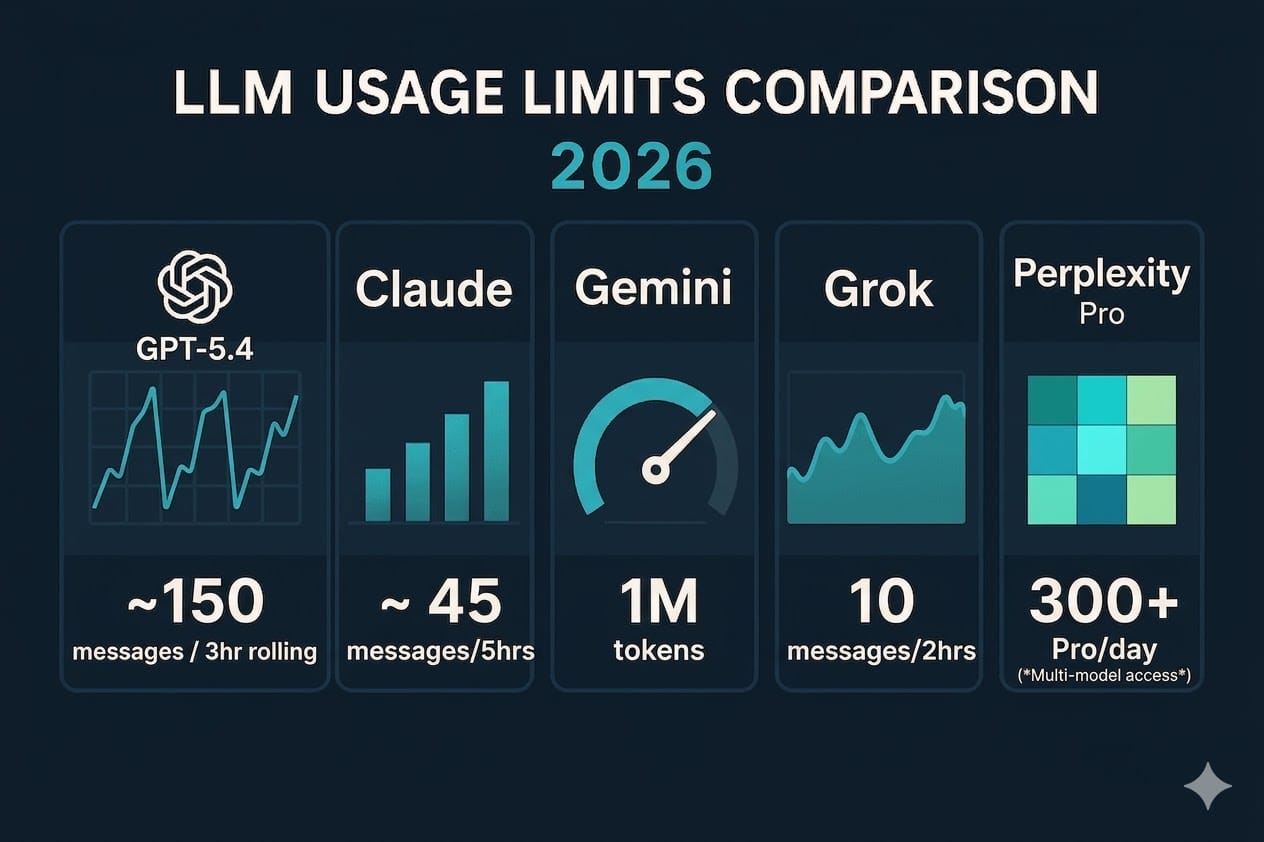
For years, “usage limit” meant a number of messages. You’d get “40 messages every three hours,” and you could count them. That model is basically gone.
Claude, Gemini, and Grok now run the same underlying thing: a compute-weighted pool. Instead of counting messages, they measure how much work each prompt actually costs — a quick question is cheap, a long coding session or a video job is expensive — and draw it from a weekly allowance that refreshes in rolling five-hour windows. Grok took it furthest with one single weekly pool spanning chat, image, voice, and Build. Google’s version weighs prompt complexity, feature use, and conversation length. Perplexity runs the same idea under a different label — credits — where only the agent spends from your balance.
Here’s why this matters for your wallet: you can no longer glance at “messages per day” and know whether a plan fits you. A heavy user of cheap prompts — quick questions all day — will sit comfortably inside a plan that a light user of expensive prompts — a couple of long video or coding jobs — blows through by Wednesday. Match the plan to the kind of work you do, not just the volume.
The new wrinkle: text is becoming free, tools are becoming the product. ChatGPT just split the two apart explicitly — unlimited text chats on Free and Go, metered file uploads, images, and tools. That’s the clearest statement yet of where the real cost sits. Plain text conversation has become cheap enough to give away at the bottom of the market; anything that touches a file, generates an image, runs a search, or drives an agent has not. Expect the other platforms to follow the same split, because it reflects what actually costs them money.
Which changes the upgrade question. “I keep running out of messages” is disappearing as a reason to pay. “I keep running out of uploads” is replacing it.
Four more patterns worth knowing:
- Subscription-plus-credits is the new normal. The flat monthly fee covers your interactive use; a metered credit pool covers agentic and programmatic work. Both Claude and Perplexity now split it this way, and Grok lets you top up from $5 rather than wait for the weekly reset.
- Promotional limits are not plan limits. Anthropic’s +50% Claude Code lift ran from May, was extended three times, and on 14 September converts into a permanent +25% measured from the old baseline — about 17% below where limits sit today. A promo can revert, and it can revert to something dressed up as an increase. Check what your plan does at baseline before you renew.
- Governments are now a release variable. Claude’s Fable 5 suspension in June wasn’t a bug or an outage — it was an export-control directive. Model availability can now shift for regulatory reasons, not just technical ones.
- Flagships turn over fast. OpenAI went from GPT-5.5 to the GPT-5.6 family, Grok from the 4.2-series to 4.5 and then to 4.6 three weeks later, Google from Gemini 3.6 Flash to 3.7, and Claude from Opus 4.8 to Opus 5 — all inside a single quarter. Whatever’s newest today has a successor in the pipeline.
The Bottom Line: Which Plan Should You Buy?
Start with the free tiers — and ChatGPT’s especially. All five are genuinely usable, and ChatGPT’s is now unlimited for text. If your use is mostly typing questions and reading answers, you may not need to pay anything at all. Find out before you subscribe.
Diagnose your wall before you upgrade. This is the decision rule the whole article comes down to: work out which limit you’re actually hitting — text volume, tool usage, or model quality — and buy only for that one. Text volume is now free on ChatGPT, so paying to fix it is money wasted. Tool and upload limits need a paid tier. Model quality needs a specific paid tier. Three different problems, three different answers, and the pricing page won’t tell you which one you have.
The $20 tier is still the sweet spot for real work. ChatGPT Plus, Claude Pro, Gemini AI Pro, and Perplexity Pro each give you the flagship-adjacent models, real research tools, and enough headroom for daily professional use. For most people doing professional work, one $20 subscription is the right answer — the only question is which ecosystem you live in.
The sub-$10 tier now has to argue for itself. Gemini AI Plus at $4.99 and ChatGPT Go at $8 were built to solve “I keep hitting the free wall.” On ChatGPT, that wall just came down for text. Go still buys you more room on files, images, and tools — but if volume was your only complaint, check whether the free tier now covers you before renewing.
The $100 shelf is where the serious competition lives. ChatGPT Pro ($100), Claude Max 5× ($100), and Gemini AI Ultra ($99.99) are all fighting for the same power user. Pick based on what you do all day: long agentic sessions and coding lean Claude; deep research and Google-ecosystem work lean Gemini; broad general capability with the newest reasoning leans ChatGPT.
Budget for credits, not just the subscription. If you’re going to use agents — Claude Code, Perplexity’s Computer, ChatGPT’s Codex — the flat fee is only half the bill. The metered pool on top is where heavy agentic work actually gets paid for.
Use more than one. The cheapest resilience strategy is a paid subscription to your primary platform plus free tiers on the rest. When your main one hits a weekly ceiling, or a model gets suspended for three weeks, you have somewhere to go.
The Evolution Continues
The one safe prediction: this table will be wrong again soon. A flagship now lasts about a quarter before a successor arrives, prices move in both directions, and a model can vanish for regulatory reasons with no notice. That’s the environment now.
You don’t need to track all of it. You need to know three things about your own plan: which model you’re actually getting, how its limit system works (compute pool, credits, or per-model allowance), and where your fallback is when you hit the ceiling. Get those three right and the churn stops mattering.
That’s also why this page carries a refresh date at the top. Check it before you trust the numbers — if it’s more than a month old, assume at least one price or model has moved.
Key Takeaways
- ChatGPT’s Free and Go tiers now have unlimited text chats (August 6) — with GPT-5.6 Luna as the default and a Think button for harder questions. Files, images, and tools are still limited.
- Plus and Pro got a better Sol and a thinking slider — one model now handles both quick answers and deep reasoning, so changing effort no longer changes personality.
- Claude Code’s weekly limits reset on September 14: a permanent +25% on the pre-promotion baseline, which lands about 17% below the boosted level most Claude Code users have today. It’s Claude Code, not chat, and it excludes Free.
- Claude Opus 5 remains the flagship — default on Max, strongest on Pro, 1M context, at Opus 4.8’s price.
- Grok 4.6 (August 12) and Gemini 3.7 Flash (August 13) are the month’s new models. Gemini’s runs inside Spark in the app, so you need AI Pro or Ultra to reach it. Gemini 4 remains in pre-training, with an “almost monthly” cadence promised afterwards.
- Diagnose the wall before you upgrade. Text volume, tool limits, and model quality are three different problems with three different answers — and only one of them is still worth paying to fix on ChatGPT.
Keep going:
- Gemini 3 Flash vs Pro: which model to use
- Codex vs Claude Code: which should you use?
- AI in 2026: a quick peek for people who don’t want to become developers
- Export guides: ChatGPT · Claude · Gemini
Last updated: September 1, 2026. Sources: OpenAI — Improving GPT-5.6 Sol in ChatGPT (August 6, 2026) and the ChatGPT release notes; Anthropic (Introducing Claude Opus 5), claude.com/pricing, the Claude Code weekly-limit promotion help-centre article, and the Claude Code announcement of August 29, 2026; gemini.google/subscriptions, one.google.com AI plans, and the Google blog (Gemini 3.7 Flash, August 13, 2026; I/O 2026 AI subscriptions); x.ai (Introducing Grok 4.6, August 12, 2026) and docs.x.ai; perplexity.ai pricing, Max help center, and changelog.