

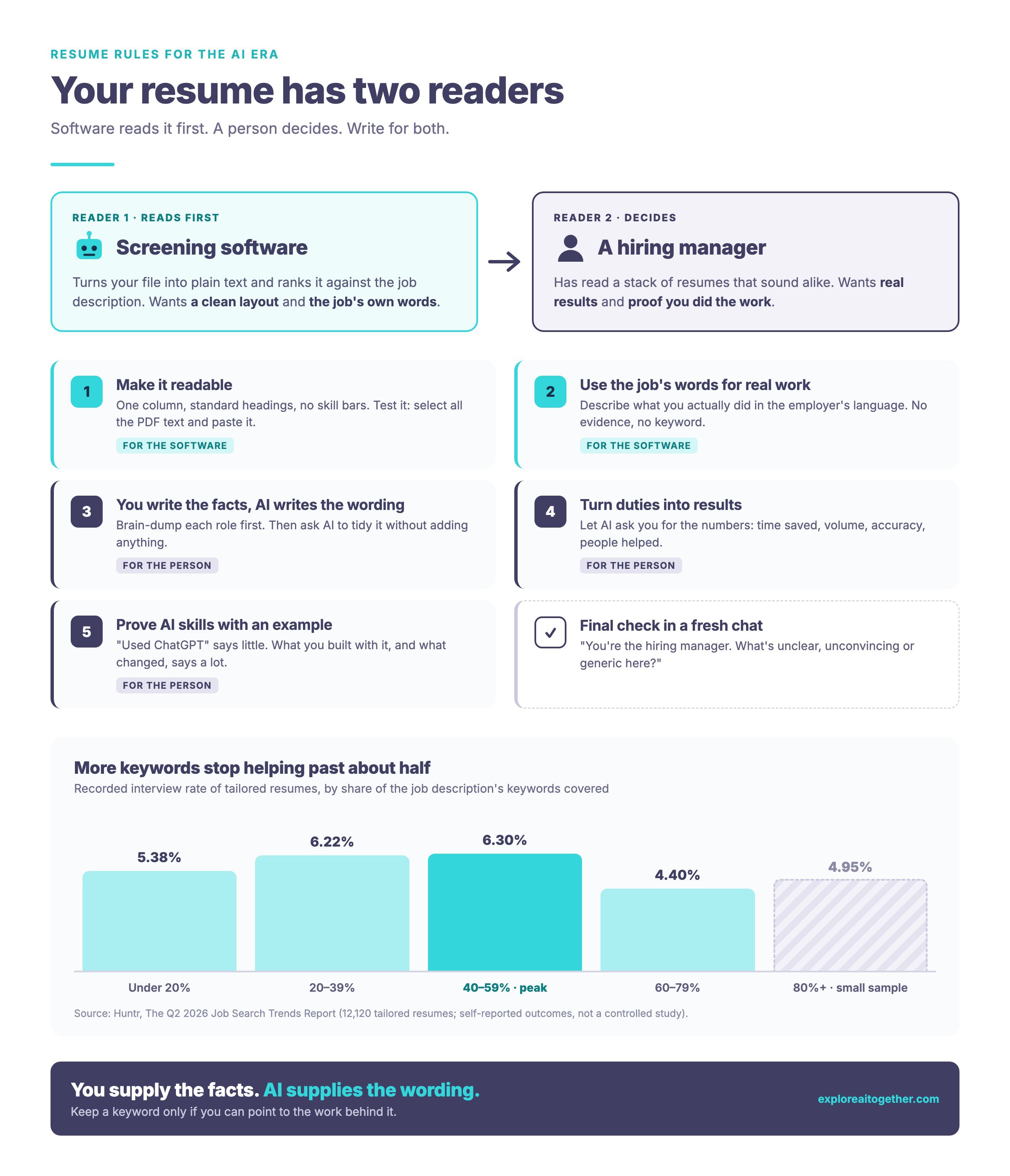
Your resume has two readers now. Software reads it first, pulling out your job titles, dates and skills and ranking you against the job description. Then a person reads it, usually someone who has already seen a stack of resumes that sound exactly alike.
AI can help you with both readers. It can also sink you with both, by stuffing in keywords you can’t back up and smoothing your real work into “results-driven professional with a proven track record.”
The split that works is simple. You supply the facts. AI supplies the wording.
Statistics checked November 1, 2026, against the original studies and surveys linked in each section.
The quick answer
- Use a plain, one-column layout and send a PDF whose text you can highlight and copy.
- Use the job description’s words only for work you’ve actually done. In one large dataset, interview rates peaked when a resume covered roughly half the posting’s keywords.
- Write the facts yourself first, then ask AI to tighten the wording without changing them.
- Turn duties into results, with a real number wherever you have one.
- Show AI skills with an example of something you did with them.
Rule 1: Make it easy for software to read
Screening software converts your resume into plain text before anything gets ranked. Columns, text boxes, icons and skill bars are where that conversion goes wrong: dates attach to the wrong job, or a whole section goes missing.
In Resume Genius’s 2026 Hiring Insights Report, a survey of 1,000 US hiring managers, 53% named text-based PDFs with no images or complex formatting as the format that works best with their screening system. Only 13% said image-heavy or heavily designed layouts are compatible.
Plenty of resume templates, AI-designed ones included, ship with two columns, icons and skill bars. They look great and parse badly.
What to use:
- One column, with standard headings: Summary, Experience, Education, Skills.
- Plain text for anything that matters. No skill bars, charts or logos.
- A PDF exported straight from your document. Scans and images can’t be read as text.
The 10-second test: open your PDF, select all the text and paste it into a blank note or a new ChatGPT chat. If it comes out complete and in the right order, the software can most likely read it too. If the text won’t highlight at all, it’s trapped in an image.
Rule 2: Use the job’s words for work you’ve actually done
Tailoring your resume to each job works. Huntr’s Q2 2026 Job Search Trends Report looked at nearly 2 million applications tracked by its users. Of those sent with a tailored resume, 5.71% were marked as reaching an interview, against 3.09% for the rest. That’s self-reported data and doesn’t prove cause, and Huntr notes the gap narrows a lot when it compares the same person’s tailored and untailored applications. The direction still holds.
Past a point, more keywords stop helping. Among tailored resumes, interview rates peaked at 6.30% for those covering 40–59% of the job’s keywords, then fell to 4.40% at 60–79%. The very top band is too small to read much into. Aim for an obvious match, and ignore any tool that pushes you toward a 100% keyword score.
The line to draw is between mapping and stuffing. Mapping uses the employer’s words to describe something you really did. If the posting says “stakeholder management” and you ran monthly reviews with three department heads, say it in their language. Stuffing is “Delivered customer service, customer support and customer-focused communication”: every phrase present, nothing proved, and the person reading it can tell.
Start with an audit before you rewrite anything:
Here is a job description and my current resume. First, list the five problems this employer most needs solved and the skills and keywords that matter most for each. Then sort every keyword into three groups: already proven in my resume, real experience I’ve worded differently, and no evidence in my resume at all. Don’t rewrite anything yet.
Rephrase only the middle group. Anything with no evidence stays out. It’s also a useful list of what to prepare for in the interview.
Rule 3: You write the facts, AI writes the wording
“Make my resume better” is the prompt that produces generic resumes. With nothing specific to work from, AI fills the gaps with the most common phrases it knows, and hiring managers have learned to spot them. In the same Resume Genius survey, 80% said they can often tell when a resume was written by AI, and 76% said AI-written resumes make it harder to understand what a candidate actually did.
Polishing your own wording has the opposite effect. In a large experiment on an online jobs platform by Emma Wiles, Zanele Munyikwa and John Horton, about 480,000 jobseekers were randomly given writing help that fixed errors in their profiles, or none. Those who got it were hired 8% more often, at 10% higher wages. The biggest gains went to people whose writing started out weakest. That tool predates ChatGPT, but the lesson carries over: clearer writing about real work helps.
So split the job in two. First, write a messy brain dump for each role, typed or dictated, covering three things: the result, what you specifically did, and how you did it. Then:
Here’s the job description and my notes on one past role. Turn the notes into three or four resume bullets. Use only the facts in my notes: don’t add numbers, tools or responsibilities I didn’t mention. If something important seems to be missing, ask me instead of guessing.
Read each bullet back. If you couldn’t explain it naturally in an interview, rewrite it or cut it.
Rule 4: Turn duties into results
“Responsible for weekly reporting” tells the reader what was in your job description. “Cut weekly reporting from two hours to 30 minutes” tells them what changed because you were there.
The hard part is usually knowing which number matters. Let the AI interview you for it:
Go through my resume one role at a time. For each bullet, ask me one question that would help me add a real number: time saved, money, volume, speed, error rate, or how many people it affected. Wait for my answer before moving on.
Time, scale, accuracy and the number of people you helped all count as much as revenue. An honest estimate (“about 40 tickets a week”) is fine. An invented one is a problem the moment an interviewer asks about it.
Once you have the numbers, Google’s own resume tips suggest a formula: accomplished X, as measured by Y, by doing Z.
Rewrite each bullet in the format “Accomplished X, as measured by Y, by doing Z.” Keep every fact and number exactly as I gave them. If a bullet has no measurable result, leave it as it is and flag it.
Rule 5: Prove AI skills with an example
Nearly everyone can type “ChatGPT” into a skills section, so it tells a recruiter very little. What you did with it is another matter. In a 2026 hiring experiment by Fabian Stephany, Ole Teutloff and Angelo Leone, 1,725 recruiters in the UK, US and Germany compared pairs of resumes. AI skills raised a candidate’s chance of an interview by roughly 8 to 15 percentage points. Formal certificates added only a moderate boost on top of skills the candidate simply stated.
The strongest version is a bullet with a result in it:
- “Cut monthly report prep from a full day to two hours by building a ChatGPT workflow that drafts the summary from our tracking sheet.”
If you don’t have a workplace example yet, do a small project aimed at the job you want and add a short Projects section: “Analyzed 100 public reviews of a competitor’s product with ChatGPT, checked the themes by hand, and wrote a one-page summary of three fixes.” Link to it if you can, even as a shared Google Doc.
Before you send it: the five-minute check
- The PDF text highlights and pastes in the right order.
- Every keyword from the job description points to real work.
- Every number is one you could explain and defend.
- No sentence could appear unchanged on someone else’s resume.
- You’ve read it out loud once. AI phrasing is easy to hear.
Then open a fresh ChatGPT chat, paste in the job description and the final resume, and ask: “You’re the hiring manager for this role. What’s unclear, unconvincing or generic in this resume?” A new chat hasn’t watched you write it, so it’s less inclined to go easy on you.
Where to go next
If you’re applying for lots of roles, a repeatable setup saves hours: the Claude Code resume builder and the Codex version tailor a base resume to each job. Once you land the interview, AI interview prep picks up from here. And if an application goes nowhere, the application autopsy helps you work out why.
The five-rule shape here follows Jeff Su’s video Write a Killer Résumé in the AI Era: 5 New Rules!, which is worth a watch. The numbers above come from the original studies and surveys.