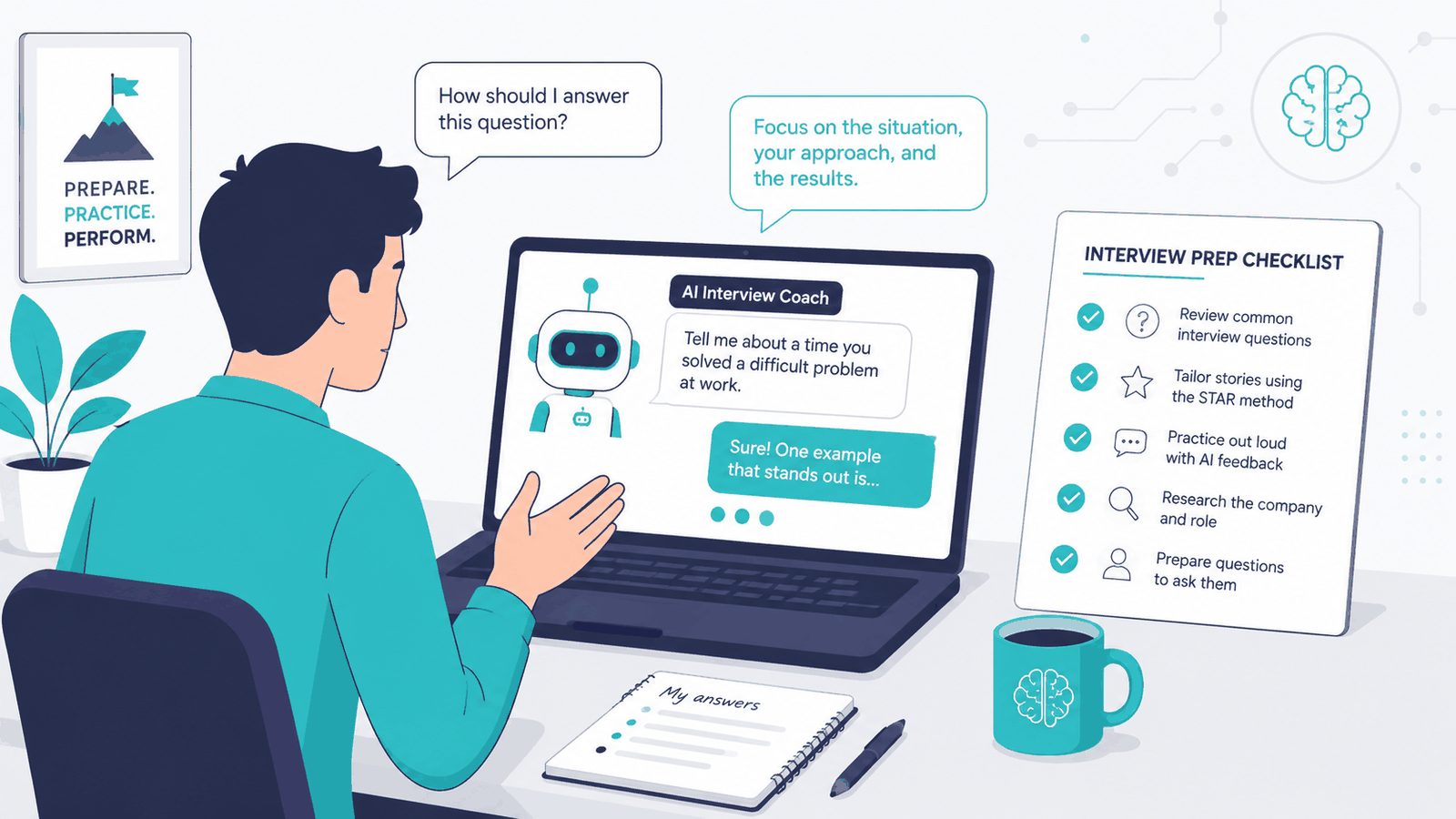
Most advice about using AI for interviews stops at one idea: ask it to run mock questions at you. That works, and there’s a right way to do it that I’ll get to. But it’s one stage of a much longer job, and it’s not even the stage where AI helps most.
The last time I prepared for a technical sales role, the entire preparation happened in one conversation. Seven stages — checking my resume against the job description, researching the company and the pay, reviewing the NDA they sent, working out what to ask the hiring manager, running the mock rounds, and finally collapsing all of it onto one page fifteen minutes before the call.
Here’s the full sequence, with the prompts.
- The seven stages
- Stage 1: Check your resume against the job description
- Stage 2: Research the company properly
- Stage 3: Work out the money before you're asked about it
- Stage 4: Have it read the contract
- Stage 5: Build the questions you're going to ask
- Stage 6: Run the mock interview
- Stage 7: Collapse it onto one page
- Why one conversation beats seven good prompts
- What this won't do
- The short version
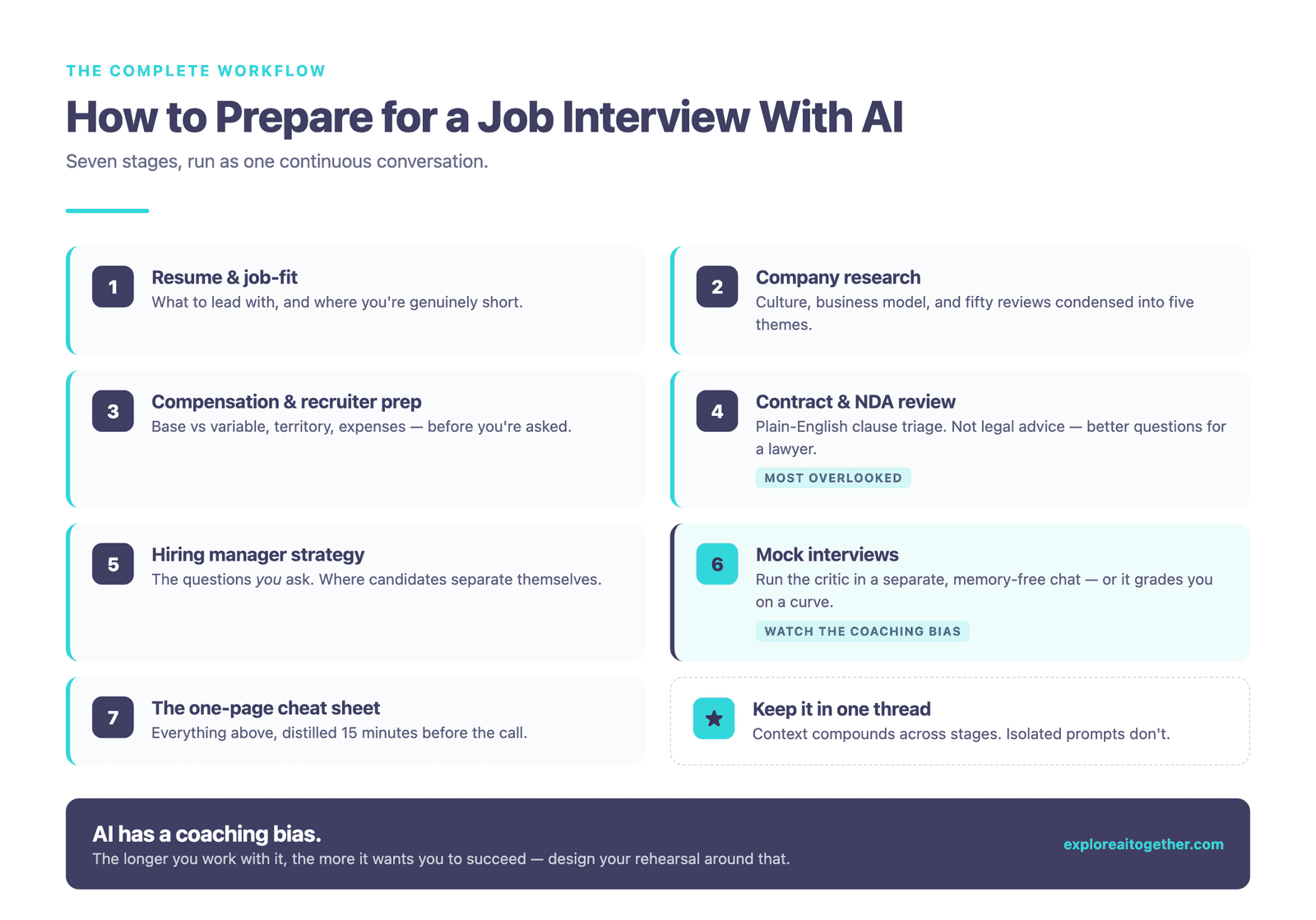
The seven stages
- Resume and job-fit analysis — what to lead with, and where you’re genuinely short
- Company research — culture, public reviews, and whether the business is any good
- Compensation research and recruiter prep — before the money conversation, not after
- Contract and NDA review — the most underrated one
- Hiring manager strategy — the questions you ask
- Mock interviews — with the fix that stops it flattering you
- The one-page cheat sheet — everything above, distilled
Run these in one conversation, in order. The reason why is at the end, and it matters more than any individual prompt.
Everything here works in ChatGPT, Claude, or Gemini. I use ChatGPT for job-search work, so that’s what the examples assume — where the tools behave differently in a way that matters, I’ve said so.
Stage 1: Check your resume against the job description
Before anything else, find out whether you’re reading the role correctly.
Here’s my resume and the job description. Where do I genuinely fit, where am I stretching, and what would a hiring manager see as the gap? Tell me which two or three parts of my background I should be leading with for this role specifically, and what I’m currently over-emphasising that doesn’t matter here.
The useful output isn’t the reassurance. It’s the reordering. Most people lead with what they’re proudest of, which isn’t always what the role is actually asking for. In my case this pulled forward a handful of specific capabilities the job description clearly cared about and pushed back other work I’d have instinctively opened with.
Ask for the gap honestly, too. Knowing the weak spot before the interview means you get to decide how to handle it, rather than improvising when someone asks.
Stage 2: Research the company properly
Two things happen here. You build real “why this company” material, and you find out whether you actually want the job.
Here’s the company and the role. Walk me through: what they do and who pays them, whether this looks like a durable business or a fragile one, what their competitive moat actually is, and what their stated company values would mean day-to-day for someone in this role.
That last part is worth its own attention. Most companies publish a set of values with a name attached. Asking what a stated value would look like in practice — for your specific role, not in general — turns a poster slogan into something you can speak to credibly, and occasionally into a genuinely useful question to ask back.
Then, separately, the reviews:
Here are the public employee reviews for this company. Don’t summarise them one by one. Tell me what patterns repeat across them, what complaints show up more than once, and what a candidate should probe in an interview as a result.
Pattern analysis is the whole point. Any individual review is one person on one bad day. The same complaint appearing eleven times is information — and it converts directly into a question you can ask without being confrontational. AI is surprisingly good at synthesising fifty mediocre reviews into five recurring themes, which is genuinely the value here: nobody is going to read all fifty carefully, and the signal only shows up in aggregate.
Stage 3: Work out the money before you’re asked about it
Compensation conversations go badly when they’re the first time you’ve thought about the numbers.
This is the role, the location, and the territory. Break down how compensation likely works here — base versus variable split, what’s realistic for this market, and what expenses or reimbursements I should be asking about. Then help me prepare for the recruiter screen specifically: what they’ll ask, what I should ask, and how to answer the salary expectation question without anchoring myself low.
Two things this catches. First, structure — in commission-heavy roles the base and the on-target earnings can tell very different stories, and knowing to ask about the split beats discovering it later. Second, the boring operational stuff nobody remembers to raise: travel expectations, mileage or expense reimbursement, what the territory actually involves.
Treat the recruiter as a distinct conversation from the hiring manager. Different person, different incentives, different questions. Preparing for them separately is worth the ten minutes.
Stage 4: Have it read the contract
This is the stage almost nobody talks about, and it might be the highest-value one in the whole list.
When an NDA or offer paperwork arrives, most people skim it and sign. Legal language is deliberately dense and reading it carefully feels like it requires training you don’t have.
Here’s an NDA I’ve been asked to sign. Explain in plain English: what the confidentiality obligation actually covers and for how long, which jurisdiction governs it, whether there’s any non-compete or non-solicit language, whether there’s an attorney-fee provision, and anything here that’s unusual or worth pushing back on. Flag the practical risks for me as a candidate.
You get a plain-English map of a document you’d otherwise sign blind, and — more importantly — a list of specific things to ask about.
Say the obvious thing out loud, though: this is not legal advice, and AI is not your lawyer. What it does well is translation and triage. It tells you which clauses exist and which ones deserve attention. If something consequential turns up — a broad non-compete, an aggressive fee-shifting provision, anything tied to equity or IP you care about — that’s the point where you pay an actual attorney, now knowing exactly what to ask them about. Using AI here makes legal advice cheaper and better targeted. It doesn’t replace it.
Stage 5: Build the questions you’re going to ask
Most candidates spend 90% of their preparation on answers and almost none on questions. The questions are where you separate yourself, because most people ask something forgettable about team culture and then stop.
Ask for questions that only make sense if you understand the business:
Based on everything we’ve covered about this company and role, give me questions to ask the hiring manager that show I’ve actually thought about their business. Not generic culture questions. Things that would be hard to ask without having done real research.
The pattern that came out of mine generalises well:
- How will you maintain your advantage as the market shifts? (name the specific shift — AI, regulation, consolidation, whatever is actually moving in their industry)
- Why do customers buy? What’s the moment they decide?
- What separates your top performers from the middle?
- Where is the product heading over the next couple of years?
- What does [their stated value] look like in practice on this team?
That last one lands especially well because it’s specific to them and impossible to fake. The fourth tells you whether the role has a future. The third is quietly the most useful question you can ask — the answer tells you exactly how you’ll be measured, and occasionally reveals that the job is not the job you thought it was.
Stage 6: Run the mock interview
Now rehearse. Give it the job description and your background, ask it to interview you one question at a time, and it does a genuinely good job — it catches the things you can’t hear yourself doing. Rambling past the point where you’d already answered. Burying your strongest example three sentences deep. Having nothing crisp for “so why this company.”
Run it long enough in a single chat, though, and it starts being nice to you.
AI has a coaching bias
The longer you work with it, the more it wants you to succeed.
That’s the part worth knowing before you lean on this. Forty minutes in, the model has the whole conversation in context — including watching you improve. So it grades on a curve. A real interviewer has no investment in your progress. They meet you once, cold, at whatever level you show up with.
It’s a genuinely useful trait almost everywhere else. In rehearsal, where the entire point is accurate feedback about how you’re actually landing, it’s the one thing you need to design around.
The basic pattern
You’re interviewing me for the role in the attached job description. My background is in the attached resume. Run a realistic interview — behavioral and technical, mixed. Ask one question at a time and wait for my answer before moving on. After each answer, tell me honestly what was weak: where I rambled, where I buried the strongest part, where I was vague. Be a skeptical interviewer, not a supportive one. Start with your first question.
Two details are doing most of the work. One question at a time matches real interview pacing — ask for twenty questions up front and you’ll get a study guide you read silently, which rehearses nothing. And skeptical matters because every one of these models defaults to encouraging. Left alone, they’ll tell you most answers are solid. They aren’t all solid.
Fix the grading curve with a second chat
The model that’s been coaching you can’t judge you cleanly afterwards. It’s seen the earlier attempts. It knows the answer you just gave is better than the one from twenty minutes ago, and that shows up as a better grade — even when the answer would land flat in a real room.
Keep your interviewer chat running. Then open a second, empty chat and paste this whenever you want an honest read:
Here’s a job description, and an answer a candidate gave to the interview question that follows. You have no other context about this person. Judge the answer on its own merits, as a hiring manager hearing it for the first time. What’s weak, what’s vague, and what would make you doubt them? Don’t soften it.
The critic has nothing to reward you for improving on. It reads the answer in front of it, which is exactly what your actual interviewer will do.
One catch, and it’s why this quietly fails for a lot of people. ChatGPT can reference your other conversations and carries saved memories between them, so a “fresh” chat often isn’t fresh — it may already know how your prep has been going, which puts the grading curve right back in. Use a Temporary Chat for the critic, or turn off memory and chat-history referencing first. Worth checking your own settings before trusting the second opinion, since the defaults have shifted more than once. Claude keeps conversations more separated, but if you’re working inside a Project holding your interview notes, the same leak applies — run the critic outside the Project.
Tell it to chase your vaguest point
Most mock interviews advance politely. You answer, it acknowledges, it moves on. Real interviewers don’t do that when they smell something soft.
When my answer is vague or I gesture at something without specifics, don’t move to the next question. Follow up on that exact point until I’ve either given you something concrete or admitted I don’t have it.
The opening question is rarely where people come apart. It’s the third follow-up on something you half-know. Someone in a thread on r/ClaudeAI described having a clean, well-rehearsed story about a migration they’d led — until the follow-ups kept asking what they’d have done differently, and it became obvious they’d never actually thought about it. Better to find that at your kitchen table.
Say your answers out loud
Typing lets you edit while you think. You quietly fix the rambling before the model ever sees it, which means it can’t catch the habit you’re trying to break.
Use voice-to-text, speak your answer the way you would in the room, and paste the raw transcript in for critique. Reading your own filler back as text is harsher than any feedback someone would give you out loud — the “so, I guess, basically” pattern is invisible when you’re speaking and glaring on the page.
Stage 7: Collapse it onto one page
Preparation has a delivery problem. By the time you’re fifteen minutes out, you’ve done the research, run the mock rounds, and built up more material than you can hold in your head while also being charming to a stranger.
The last prompt I run before an interview is this one:
Can you generate a 1 page cheat sheet for me — my interview is in 15 min. No wall of text, just questions to ask, and highlights to not forget about my related accomplishments. Here’s the resume I used.
The constraints are the whole prompt. One page stops it writing an essay you’ll never read in time. No wall of text gets you something scannable at a glance. And asking specifically for questions to ask plus accomplishments not to forget covers the two things people most reliably blank on under pressure — they forget to interview the company back, and they forget the exact achievement that made them a fit in the first place.
Run it in the same conversation as everything above, so it distils work you’ve already done rather than inventing fresh material cold. If you genuinely have run out of time and skipped the rest, it still works — it’s just doing less.
Why one conversation beats seven good prompts
This is the part that matters most, and it’s easy to miss because it isn’t a prompt.
Every stage above could be run as an isolated request in a fresh chat, and each would produce a reasonable answer. Run in sequence in one conversation, they produce something better. By the time you reach the mock interview, the model has already worked through your resume, the job description, the company’s business model, the review patterns, and the questions you care about. It asks sharper interview questions because it knows what the role is actually for. The cheat sheet works because it’s summarising a body of work rather than a document.
Isolated prompts each produce a decent answer. The running conversation produces preparation.
The one deliberate exception is the critic chat, which stays separate and ignorant on purpose. Everything else compounds. The critique specifically must not.
If you’re earlier in the process, the resume deserves the same treatment: How to Use Claude Code to Build a Job-Specific Resume and the Codex version of the same workflow cover getting past the screen that gets you into the room.
What this won’t do
It won’t guarantee an offer. Plenty of people run exactly this preparation and still get rejected, for reasons that have nothing to do with how well they answered — internal candidates, budget changes, a stronger applicant. Better preparation improves your odds. It doesn’t control the outcome.
It can’t tell you what a specific interviewer cares about. The model is inferring from a job description, which is often a wish list written by someone who isn’t in the room.
It isn’t a lawyer, an accountant, or a recruiter, and the contract stage especially is triage rather than advice.
And there’s a slightly uncomfortable reason the mock questions feel so accurate: if your practice questions turn up nearly verbatim in the real interview, that may say more about the hiring manager using the same tools to write theirs than about the model reading their mind. Convenient for you. Worth a wry smile rather than a conclusion about your own preparedness.
The short version
Check your resume against the job description before you assume you know the role. Research the business, not just the culture page. Work out the money before someone asks you about it. Have the contract explained to you in plain English, then get a lawyer if anything real turns up. Build questions that prove you did the work. Rehearse with a skeptic, and move the critique to a genuinely clean chat so it can’t grade you on improvement. Then put the whole thing on one page.
Do it in one conversation, in that order.
AI didn’t get me the interview.
It didn’t answer the questions for me.
It didn’t negotiate my salary.
What it did was make sure I wasn’t encountering any of those conversations for the first time in the room.
That’s the difference between asking AI for interview questions and using it as a genuine interview coach.
And if the answer comes back no, Why Didn’t I Get the Job? is the post-mortem version of this — same idea, applied after the fact.