
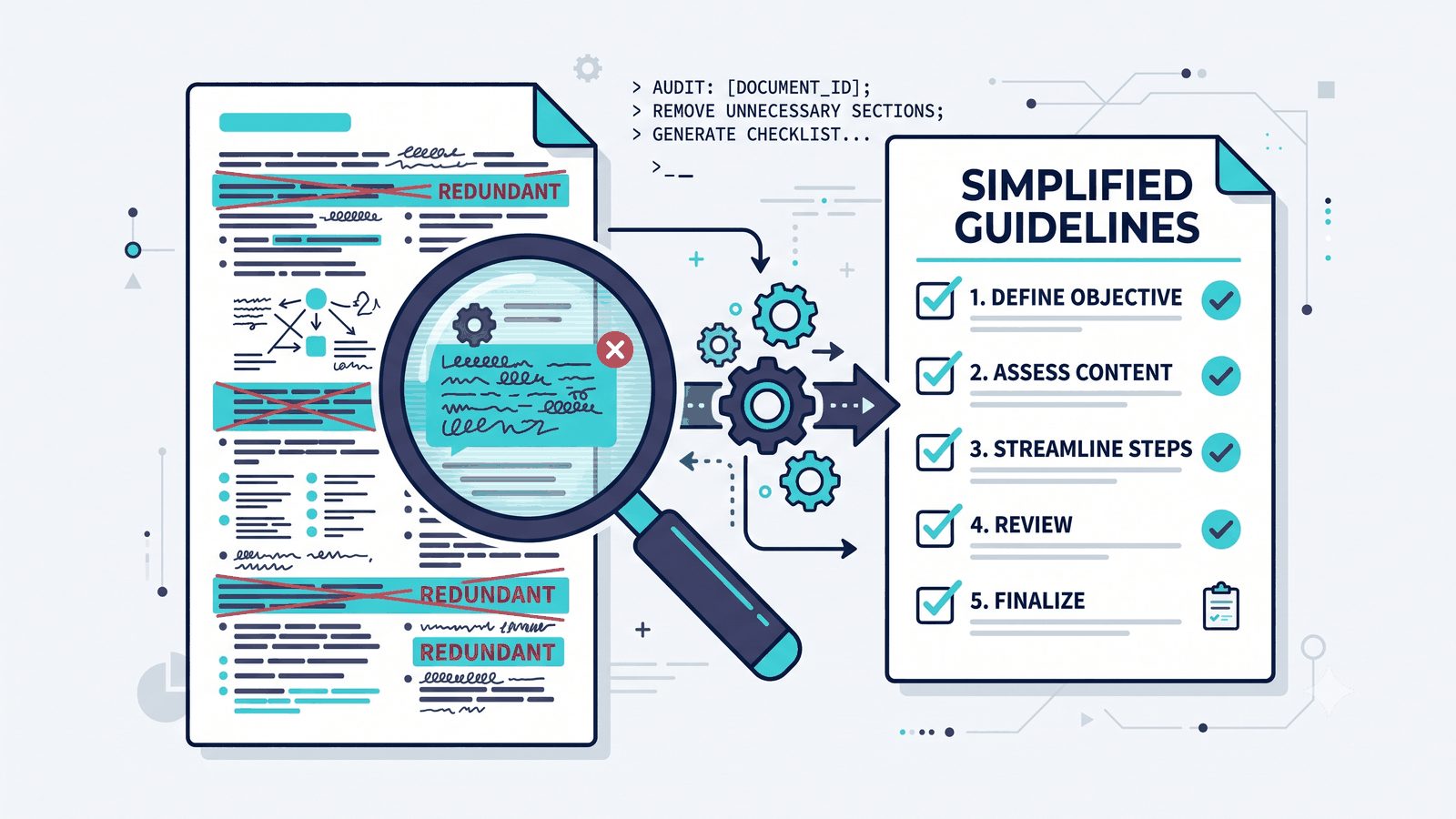
Your CLAUDE.md is the file Claude Code reads at the start of every session — the standing instructions for how it should work in your project. You wrote it once, it made things better, and you moved on.
Then Anthropic shipped a new model. And another. Your file didn’t change. Some of the rules you wrote to babysit an older model are now telling a smarter one to do things it already does on its own. Those rules aren’t helping anymore — they’re noise, competing for attention with the rules that still matter.
Keeping the file current is a maintenance job, and it’s exactly the kind of job you can hand back to Claude. Here’s the prompt that does it.
The prompt
Paste this into Claude Code, inside the project whose CLAUDE.md you want to tune:
Read my CLAUDE.md file. Then fetch Anthropic’s current Claude Code documentation (start at code.claude.com/docs and find the CLAUDE.md / memory best-practices guidance) so you’re working from the current recommendations, not your training data. Note what the latest Claude models now handle natively. Audit my file against three standards: 1. The include/exclude test — a line earns its place only if removing it would cause you to make a mistake. Flag anything you could figure out by reading the code, standard conventions you already follow, changelog or session notes, long explanations, and examples. 2. Redundancy with the current model — flag rules that tell you to do something a current frontier model already does by default. Useful on older models; now just noise. 3. Signal-to-noise — every rule should name a specific mistake it prevents. Flag vague “be careful / be thorough” rules that aren’t testable. Then show me a table of every rule with a verdict — keep, rewrite, or cut — and a one-line reason, plus a revised CLAUDE.md tightened to the essentials. Don’t overwrite my file. Show me the proposed version first and wait for my go-ahead.
That’s the whole thing. Claude reads your file, goes and reads Anthropic’s current guidance instead of trusting whatever it remembers, and hands you a tighter version with a line-by-line rationale. Nothing gets overwritten until you say so.
Why it reads the docs first
The obvious version of this is just “make my CLAUDE.md better.” That version quietly bakes in the staleness you’re trying to remove. Claude’s training has a cutoff, and best practices move faster than any cutoff — so a from-memory cleanup measures your file against advice that’s already a few models old.
Telling it to fetch the live documentation first means the audit is measured against what Anthropic recommends today. That single instruction is the difference between a real cleanup and an educated guess.
What good output looks like
When it works, you get two things back:
- A table of every rule with a verdict — keep, rewrite, or cut — and a one-line reason for each.
- A revised CLAUDE.md, shorter than the one you started with, ready to paste in.
Most of the time, an audit cuts more than it adds — and the things it flags tend to fall into the same three buckets: rules the current model already handles on its own, near-duplicates written slightly differently, and vague instructions that don’t name a specific mistake. When you see a run of “cut” verdicts, that’s the prompt doing its job.
Two variants
If you just want the diagnosis, not a rewrite:
Read my CLAUDE.md and audit it against Anthropic’s current Claude Code best-practices docs (fetch them first) and what the latest Claude models handle natively. Give me a keep / rewrite / cut table with a one-line reason per rule. Don’t write a new file — I just want the diagnosis.
If you don’t have a CLAUDE.md yet:
I don’t have a CLAUDE.md yet. Read my project, fetch Anthropic’s current Claude Code best-practices docs, and draft a minimal one. Only include rules that would prevent a real mistake in this specific codebase — bash commands you can’t guess, style rules that differ from the defaults, test commands, known gotchas. Skip anything you’d already do by default. Keep it short, and show it to me before writing the file.
What it won’t do
It can’t read your mind about project-specific rules. It keeps the ones already in the file, but it can’t invent the gotcha you never wrote down.
The docs-fetch depends on Claude actually having web access in your setup. If it can’t reach the page, it falls back on training knowledge — so ask it to tell you which one it used, and don’t assume it fetched anything.
And it’s a proposal. You still own the file. Read the cut list before you accept it; every so often a rule looks redundant but is quietly load-bearing for your specific workflow. Keeping the human in the loop is the whole reason the prompt stops and asks before overwriting.
Run it whenever Anthropic ships a model you actually switch to. New model, quick audit, tighter file — that’s the natural rhythm.
The file doesn’t need to be long to be good. It needs to match the model reading it, and keeping it that way is now one paste away.
If you haven’t built the underlying memory setup yet — the file itself, what belongs in it, how it fits with skills and project context — Stop Repeating Yourself: How to Make Claude Code Actually Remember covers that groundwork. This is how you keep it lean afterward.