Last Updated: May 29, 2026
If you’ve been using AI tools for a while, you already know the frustration: you find a workflow that clicks, you rely on it, and then one Tuesday morning something changes. A limit tightens. A plan gets restructured. A model you counted on gets sunsetted.
This guide exists to cut through that noise.
What you’ll find here is a current, practical breakdown of usage limits, pricing, models, and features across ChatGPT, Claude, Gemini, Grok, and Perplexity — as of May 2026. It’s not a “best AI” ranking. There’s no winner. Different platforms are better for different things, and your workflow probably looks nothing like the next person’s.
The goal is simple: enough accurate information to pick the right tool (or combination of tools) for what you actually do.
What’s Changed Since Mid-May 2026
Mid-May was busy. Late May brought a few more.
GPT-5.5 replaced GPT-5.4 across paid ChatGPT tiers on April 23. Plus, both Pro tiers, Business, and Enterprise all now run on GPT-5.5 as the flagship, with a new GPT-5.5 Pro variant for Pro and Business tiers. Then on May 5, OpenAI made GPT-5.5 Instant the default model for every ChatGPT user — replacing GPT-5.3 Instant. OpenAI’s internal evals show 52.5% fewer hallucinated claims on high-stakes prompts (medicine, law, finance). GPT-5.3 Instant stays accessible to paid users through August before retirement. If a guide you’re reading still references GPT-5.4 anywhere, that’s a tell it hasn’t caught up. See also: How to Get GPT-4o Back After the GPT-5 Update — the model-transition pattern keeps repeating.
ChatGPT added personal finance tools on May 15. Pro subscribers in the US can now connect bank accounts, brokerages, and credit cards via Plaid — over 12,000 financial institutions supported. Memory sources also launched May 5, giving every ChatGPT user visibility into what context was used to personalize a response. How I Use ChatGPT to Invest in Stocks covers what that actually looks like in practice.
ChatGPT for Excel and Google Sheets is now global. A spreadsheet-native sidebar that builds, cleans, updates, and explains workbooks. Free preview for Business customers through June 2, 2026. Worth comparing against Gemini’s existing Sheets integration before picking one.
Gemini 3.1 Pro hit the Gemini app properly on May 4. Google had launched it in February as a developer preview, but the consumer rollout — with expanded limits for AI Pro and Ultra subscribers — happened May 4. NotebookLM picked up Gemini 3.1 Pro for paid users around the same time. For a deeper look at how 3.1 Pro compares to 3 Flash in everyday use, see our Gemini 3 Flash vs Pro guide.
Grok 4.3 became the default on May 15. xAI retired grok-4-1-fast, grok-4-fast, grok-4, grok-code-fast-1, and grok-imagine-image-pro. Requests to those model strings now redirect to grok-4.3 at standard pricing. The “Beta for Heavy only” framing from April is over.
Comet is free. Perplexity’s AI browser, which launched in July 2025 as a $200/month perk, became free for everyone on March 18, 2026. Comet for Android launched in May, completing the rollout across iOS, Android, Windows, and Mac. Comet Plus, a $5/month add-on for premium publisher content, is included free with any Perplexity Pro or Max subscription. That said — there are real reasons to be cautious about AI browsers right now, and free doesn’t change the safety questions.
DALL-E 2 and DALL-E 3 retired May 12. ChatGPT Images 2.0 (launched April 21) is the current image model. If you have prompts that explicitly call older DALL-E versions, they no longer work. Here’s how to get the most out of ChatGPT’s current image generation.
Google AI Ultra dropped to $99.99/month. At I/O 2026, Google cut the Ultra price from $249.99 to $99.99 — a 60% reduction that puts it directly in the same bracket as ChatGPT Pro $100 and Claude Max 5x. A $200/month tier also exists with higher limits and 20 TB storage. The $249.99 price is gone. If you looked at Ultra before and ruled it out on cost, the math has changed.
Gemini 3.5 Flash launched May 19. A new API model with stronger coding and agentic benchmarks than Gemini 3.1 Pro at roughly 25% lower cost. Primarily relevant if you build on Gemini’s API, but worth tracking as it filters into consumer access.
Anthropic doubled the Max plan 5-hour rate limit. Effective May 2026, the session rate limit for Max plan users was approximately doubled — longer uninterrupted working sessions before hitting a wall. If peak-hour throttling was your main frustration with Max, this is a meaningful change. Pro users may still see the original friction; the doubling is specific to Max.
Anthropic announced a programmatic credit pool change — effective June 15. Starting June 15, usage through third-party apps, the Agent SDK, or claude -p will draw from a separate monthly credit pool rather than your regular subscription quota. Pro gets $20/month in programmatic credits, Max 5x gets $100, Max 20x gets $200. If you run programmatic Claude workflows through your subscription, worth understanding before the change hits. More detail in the Claude section below.
Quick Comparison: All Five Platforms at a Glance
| Feature | ChatGPT OpenAI | Claude Anthropic | Gemini | Grok xAI | Perplexity Perplexity AI |
|---|---|---|---|---|---|
| 🆓 FREE TIER | |||||
| Free Model | GPT-5.5 Instant NEW | Claude Sonnet 4.6 (limited) | Gemini 3 Flash | Grok 4.3 (limited) NEW | Sonar (basic search) |
| Free Message Limit | Limited daily; degrades to fallback at cap | Limited daily; varies with demand | Limited daily; Pro models paid-only as of Apr 1 | ~10 requests / 2 hrs (estimated) | 5 Pro Searches/day; unlimited standard |
| Ads on Free Tier | ✗ Yes — US, AU, NZ, CA | ✓ No ads | ✓ No ads | ✓ No ads | ✓ No ads |
| 💵 BUDGET PAID (~$8–10/mo) | |||||
| Plan Name | Go | — | Google AI Plus | SuperGrok Lite | — |
| Monthly Price | $8/mo | — | $7.99/mo | $10/mo | — |
| Key Features | 10x free messages, includes ads (US, AU, NZ, CA) | — | Enhanced 3.1 Pro, Veo 3.1 Lite, Gemini in Gmail, 200 GB storage | Basic Aurora/Imagine, 2x longer chats, 1 AI agent | — |
| 💳 INDIVIDUAL PAID (~$20/mo) | |||||
| Plan Name | Plus | Pro | Google AI Pro | SuperGrok | Pro |
| Monthly Price | $20/mo | $20/mo ($17 annual) | $19.99/mo | $30/mo | $20/mo ($200/yr) |
| Top Model Access | GPT-5.5 Thinking | Claude Opus 4.7 | Gemini 3.1 Pro | Grok 4.3 | GPT-5.5, Opus 4.7, Gemini 3.1 Pro |
| Context Window | 1M tokens | 1M tokens | 1M tokens | 2M tokens (4.1 Fast) | 200K tokens (Sonar) |
| Deep Research | ✓ 10 runs/mo | ✓ Included | ✓ Expanded access | ✓ DeepSearch mode | ✓ Core strength |
| Image Generation | ✓ ChatGPT Images 2.0 | ✗ None native | ✓ Nano Banana Pro / Veo | ✓ Aurora / Imagine | ✓ Multi-model |
| Voice Mode | ✓ Advanced Voice | ✓ Included | ✓ Gemini Live | ✓ Voice Mode | ✓ In Computer |
| Memory | ✓ + Memory sources | ✓ All tiers (incl. free) | ✓ Included | ✗ No persistent memory | ✓ Thread history |
| Real-Time Web Search | ✓ | ✓ | ✓ + Google Search grounding | ✓ + live X/web data | ✓ Core product feature |
| 🚀 PREMIUM / POWER TIER ($100–$300/mo) | |||||
| Plan Name | Pro $100 / Pro $200 | Max | Google AI Ultra | SuperGrok Heavy | Max |
| Monthly Price | $100/mo (5x) or $200/mo (20x) | $100/mo (5x) or $200/mo (20x) | $99.99/mo (5x) or $200/mo (20x) UPDATED | $300/mo | $200/mo |
| Key Extra Value | GPT-5.5 Pro, 5x or 20x Codex, max Deep Research, expanded Sora, personal finance preview (Pro, US) | 5x or 20x usage vs Pro, doubled 5-hr rate limit, Claude Code Auto mode, Claude Design, early access UPDATED | Veo 3.1, 10K+ AI credits/mo, Deep Think, Gemini Agent, Project Genie, 20 TB storage, YouTube Premium UPDATED | Grok 4 Heavy (multi-agent system), highest rate limits, Big Brain Mode, Custom Skills | Perplexity Computer (19 AI models), unlimited Labs, 10K monthly credits, no usage caps |
| 🏢 TEAMS / BUSINESS | |||||
| Team Plan Price | $20/seat/mo annual $25/seat monthly | $25/seat/mo annual $30/seat monthly | $20–$30/seat/mo Workspace add-on | $30/seat/mo | $40/seat/mo annual Enterprise Pro |
| Data Not Used to Train | ✓ Business+ | ✓ Team+ | ✓ Workspace | ✓ Business+ | ✓ Enterprise Pro+ |
| Coding / Agent Tools | Codex + PAYG Codex seats | Claude Code, Cowork, Dispatch | Jules (async coding agent) | Big Brain Mode, DeepSearch | Perplexity Computer (Max) |
| 🔍 WHAT MAKES EACH DISTINCT | |||||
| Standout Edge | Broadest feature set; GPT-5.5 fuses reasoning + coding; personal finance + Sheets integrations | Strongest agentic coding (Opus 4.7); leads long-context work; Claude Design for visuals | Deepest Google Workspace integration; Ultra now competitive at $99.99 | Real-time X data; 2M context window; most permissive content policy | Best for research; cites every source; multi-model access in one subscription |
| Biggest Limitation | Ads on free/Go tiers; opaque usage caps; constant pricing churn | No native image generation; programmatic credit pool change June 15; peak-hour throttling (Pro) | Free tier Pro models removed (Apr 1); API free tier tightened; Ultra had steep gap — now fixed at $99.99 | No persistent memory at any tier; no published cap numbers; $30/mo premium vs rivals | Not for creative writing; shorter context window; not a general-purpose assistant |
Usage limits on free and paid tiers aren’t always publicly disclosed and vary by demand, region, and account history. Data verified May 29, 2026.
May 2026 pricing note: OpenAI and Anthropic share the $100/5x and $200/20x premium tier structure. The differentiator is what each platform does with those tokens — Claude leads on agentic coding, ChatGPT leads on breadth and integrations. Google’s Ultra price cut at I/O now means all three major players have a ~$100 power tier, which is a bigger shift than it sounds. A sub-$10 budget category has also crystallized into something real — ChatGPT Go, Google AI Plus, and SuperGrok Lite now compete here.
ChatGPT (OpenAI)
OpenAI’s ChatGPT runs on seven subscription tiers, and a lot has moved since April. GPT-5.5 replaced GPT-5.4 as the flagship across all paid tiers on April 23. On May 5, GPT-5.5 Instant became the default model for every user — free, Go, Plus, everyone. Personal finance tools launched May 15 for US Pro subscribers. ChatGPT for Excel and Google Sheets went global. The lineup is still seven tiers, but what each does is genuinely different from six weeks ago.
The free plan now runs on GPT-5.5 Instant with a catch: it’s limited, it degrades to a lighter model when you hit the cap, and — as of February 2026 — it comes with ads. The rollout has expanded to Australia, New Zealand, and Canada. If you’re on the fence about upgrading, that last point might push you.
The Plans
Free ($0) gets you GPT-5.5 Instant access, basic file and image uploads, web browsing, and the ability to use (not create) custom GPTs. Your conversations may be used to train OpenAI’s models by default — opt out in Settings → Data Controls.
Go ($8/month) is the budget tier, launched globally in early 2026. More message volume than free, same ad situation. What it doesn’t include: advanced reasoning models, Sora, Codex, Agent Mode, or Deep Research. If you use ChatGPT for professional work, skip Go and go straight to Plus. The $12 difference buys you a completely different product.
Plus ($20/month) is where ChatGPT becomes a serious work tool. GPT-5.5 Thinking, 1M token context, Deep Research (10 runs/month), Sora video, Codex, Agent Mode, memory sources, and personalization from past chats and connected Gmail. The price hasn’t moved in three years while the product has expanded substantially. For most individuals doing real work, this is the right tier.
Pro $100 ($100/month) is the middle tier added on April 9, 2026 — slotted between Plus and the original Pro. You get the same model suite as Pro $200, including GPT-5.5 Pro and unlimited Instant and Thinking access, but at 5x usage instead of 20x. The practical difference is ceiling, not capability. If you’ve been bumping into Plus limits but nowhere near what the $200 plan is built for, this is the tier that used to not exist.
⚠️ Note — Codex promo ended May 31: The promotional 10x Codex boost for Pro $100 subscribers ended May 31. The plan has reverted to the standard 5x multiplier.
Pro $200 ($200/month) remains the top individual tier. Everything in Pro $100, plus 20x usage vs Plus. For genuinely heavy users running long multi-step reasoning or agentic coding sessions daily, the extra headroom matters.
Pro subscribers in the US also got access to a personal finance preview on May 15 — connect bank accounts via Plaid (12,000+ institutions) for spending analysis, portfolio performance, and budget planning. Here’s how I’ve actually been using ChatGPT for investing decisions.
Business ($20/seat/month annual, $25 monthly) includes SAML SSO, an admin console, and conversations not used for training by default. Pay-as-you-go Codex-only seats are available for teams that want AI coding access without rolling everyone onto full Business seats.
Enterprise (custom pricing) adds SCIM, SLAs, compliance certifications, and custom data retention. API access is billed separately on all plans.
Models Right Now
GPT-5.5 launched April 23 as the flagship across Plus, both Pro tiers, Business, and Enterprise. It fuses the GPT and Codex coding architectures into one model — no switching between reasoning mode and coding mode. AIME 2025 benchmark: 65.4 → 81.2.
GPT-5.5 Pro is the same model with higher-effort reasoning, reserved for Pro and Business tiers.
GPT-5.5 Instant became the default for every user on May 5, replacing GPT-5.3 Instant. OpenAI’s benchmarks show 52.5% fewer hallucinations on high-stakes prompts, tighter answers, fewer unnecessary follow-up questions. GPT-5.3 Instant stays available for paid users through August 2026.
GPT-5.2 Thinking sunset June 5, 2026. If anything you use still touches it, migrate now.
On Usage Limits
OpenAI is notably vague about specific message caps. What’s consistently observed: Plus users have generous limits for most workflows, but complex multi-step reasoning or large-context tasks eat through them faster. If you’re regularly hitting walls, the $100 Pro tier is likely the answer before committing to $200.
Image Generation and Spreadsheets
DALL-E 2 and DALL-E 3 were retired May 12. ChatGPT Images 2.0 is the current model — Instant Mode is available to everyone including free users, while Thinking Mode (reasoning, web search, and character consistency across up to 8 images) is gated to Plus and above. Here’s how to get more out of the current image model.
ChatGPT now has a spreadsheet-native sidebar for Excel and Google Sheets. Free preview for Business customers through June 2, 2026. Combined with the Pro-tier personal finance preview, OpenAI is clearly pushing into territory that overlapped with Microsoft Copilot and Gemini in Workspace.
Claude (Anthropic)
Claude is the choice for people who care deeply about coding quality and long-document work. The Opus 4.7 release on April 16 extended that lead — it’s the strongest agentic coding model on the market by published benchmarks. A few important updates landed since then, including one that materially affects anyone running Claude automations through their subscription.
The Plans
Free ($0) provides Claude Sonnet 4.6 with daily limits that vary by server demand. Available on web, iOS, Android, and desktop — no credit card required. Memory from chat history is available on free; Anthropic rolled this to all tiers. Limits are real. If you’re doing substantial work, you’ll feel them.
Pro ($20/month, $17/month annual) opens up the full tool suite: Claude Code in the terminal, file creation and code execution, unlimited projects, Google Workspace integration, remote MCP connectors, and access to extended reasoning models including Opus 4.7. About 5x more usage than free, though Anthropic doesn’t publish exact numbers. Claude Design — the visual output tool for prototypes, slides, and one-pagers — is available on Pro and rolling out gradually. (Beginner’s guide to Claude Design here.)
Max ($100/month or $200/month) is built for people who routinely bump into Pro’s caps. Two tiers: 5x more usage at $100, or 20x more at $200. Max adds persistent memory across conversations, Claude Code Auto mode (the agent acts independently without asking for constant confirmation — available as of April 2026), early access to new features, and priority access during peak times. As of May 2026, the 5-hour session rate limit for Max users was approximately doubled — making sustained sessions significantly more practical. If you spend hours per day in Claude on intensive tasks, the math on Max 5x often works out.
Third-party agents note: As of April 4, 2026, Claude Pro and Max subscriptions no longer power third-party agent frameworks. Automated Claude workflows through tools like OpenClaw now require pay-as-you-go API access or a direct API key. Affected subscribers received a one-time credit equal to their monthly plan cost.
Team ($25/seat/month annual, $30 monthly) adds collaboration features, shared projects, and workspace admin controls. Premium Team seats at $150/month add the full Claude Code developer environment. Minimum 2 users.
Enterprise (custom) adds SSO, audit logging, enhanced context, compliance APIs, and institution-wide controls. Self-serve Enterprise plans are now available directly on the website — no sales conversation required.
Models Right Now
Haiku 4.5 — fastest and cheapest, for high-volume latency-sensitive tasks. API: $1 / $5 per million tokens.
Sonnet 4.6 — the workhorse. Released February 17, 2026. Anthropic’s own data shows developers using Claude Code preferred it over the previous flagship Opus 4.5, 59% of the time. API: $3 / $15 per million tokens.
Opus 4.7 — the current flagship, released April 16, 2026. Agentic coding improved significantly: SWE-bench Verified jumped from 80.8% to 87.6%. Vision now supports images up to 2,576px. A “task budget” feature lets you set a token target for long-running agentic loops — the model tracks its own progress and wraps up gracefully rather than running dry mid-task. Available across Claude.ai, API, Amazon Bedrock, Google Vertex AI, Microsoft Foundry, and GitHub Copilot. API pricing unchanged at $5 / $25 per million tokens — but a new tokenizer means the same text can use up to ~35% more tokens than on Opus 4.6. Test your workload before assuming cost parity.
What’s Worth Knowing
Claude doesn’t generate images. Still true in 2026. If image generation is part of your workflow, you’re pairing Claude with something else — or using Claude Design for the visual work it does handle.
The Pro-to-Max jump is steep. Nothing between $20 and $100 for individual consumers. With Google Ultra now at $99.99, three platforms compete at ~$100 — which makes Claude’s gap more visible by comparison.
Claude Code integrates with VS Code, JetBrains, and the desktop app. Auto mode on Max reduces friction significantly for longer tasks.
Usage limits update (May 2026): Anthropic approximately doubled the 5-hour rate limit for Max plan users. That’s the good news. The peak-hour throttling issue that affected Pro users since March (roughly 5–11am PT / 1–7pm GMT) is still present at the Pro tier — the rate limit doubling was specific to Max. More on AI models having off days.
Coming June 15 — programmatic credit pool: Any Claude usage through third-party apps, the Agent SDK, or claude -p will move to a separate monthly credit allocation — $20 for Pro, $100 for Max 5x, $200 for Max 20x. Anthropic framed it as a bonus pool on top of your subscription. In practice, it separates interactive chat from automated workflows. If you’ve been running heavy automations through your subscription quota, check whether your usage fits within those amounts before June 15. Interactive chat through Claude.ai is not affected.
Gemini (Google)
Google’s AI subscription lineup spans four consumer tiers: Free, AI Plus, AI Pro, and AI Ultra. The naming overhaul from earlier this year stuck — “Gemini Advanced” is now “Google AI Pro.” Gemini 3.1 Pro is the current flagship and got its major consumer rollout on May 4.
And then at I/O 2026, Google cut the AI Ultra price from $249.99 to $99.99. That’s the headline. A $200/month tier also exists for higher limits and 20 TB storage. The $249.99 price is gone.
If you’re deep in Google’s ecosystem — Gmail, Docs, Sheets, Drive, Meet — Gemini deserves a harder look than most AI comparisons give it. (Confused about which Gemini model does what? This breaks it down.)
The Plans
Free gives you Gemini 3 Flash, restricted Deep Research, Gemini Live voice, Canvas, Gems, and 100 monthly AI credits for video generation. NotebookLM is included. A genuinely useful free tier for casual exploration. One important change to flag: as of April 1, 2026, Google removed free access to all Pro-class models. Gemini 3.1 Pro, 3 Pro, and 2.5 Pro are now paid-only. Gemini 3 Flash remains available on the free tier, but if you were relying on free access to Google’s flagship models, that era ended in April.
Google AI Plus ($7.99/month) is the budget paid tier that rolled out worldwide in January 2026. It expands access to Gemini 3.1 Pro beyond what free gets, adds limited Veo 3.1 Lite video generation, Nano Banana Pro for images, and lifts AI Studio limits. Gemini in Gmail is included; storage goes from 15 GB to 200 GB. It’s a low-cost bridge for users who want better-than-free access without the full $19.99 Pro commitment — similar in spirit to ChatGPT Go.
Google AI Pro ($19.99/month, first month free) is the full package for most users. Access to Gemini 3.1 Pro, expanded Deep Research, 1M token context window, 1,000 monthly AI credits, video via Veo 3.1, and Gemini integrated directly into Gmail, Docs, Sheets, and other Workspace apps. Higher limits in Gemini Code Assist and the Jules async coding agent. NotebookLM upgrades to 5x more audio overviews. The free first month is a low-risk way to evaluate the Workspace integration before committing. (Beginner’s guide to Gemini Deep Research here.)
Google AI Ultra ($99.99/month or $200/month) — here’s the change that matters. Google cut the entry price from $249.99 to $99.99 at I/O 2026. At $99.99, you get full access to Gemini 3.1 Pro with high usage limits, Deep Think, Veo 3.1, 10,000+ monthly AI credits, and Project Genie (US-only). The $200/month tier goes further — up to 20x more usage versus AI Pro, 20 TB storage, and YouTube Premium. Before this cut, Ultra was hard to recommend unless you were already paying for YouTube Premium and needed extra storage. At $99.99, it’s worth a genuine look — especially for heavy Gemini Workspace users who are regularly hitting AI Pro limits. Verify current pricing and included features at Google’s official Gemini page before subscribing, as these are evolving quickly.
Workspace add-ons (Business/Enterprise) are separate from consumer Google AI plans and require an active Workspace subscription.
Models Right Now
Gemini 3.1 Pro is the current consumer and API flagship. Major consumer rollout on May 4. NotebookLM vs Gemini here if you’re figuring out which Google AI tool fits which job.
Gemini 3 Flash is the default Flash model — fast and capable for most real-world tasks.
Gemini 3.1 Flash-Lite launched in March 2026 for developers — the cheapest production-ready API from any major provider right now.
Gemini 3.5 Flash launched May 19. A new API model with stronger coding and agentic benchmarks than Gemini 3.1 Pro at roughly 25% lower cost. Primarily an API story for now, worth tracking as it moves into consumer tiers.
What’s Worth Knowing
Gemini’s real advantage isn’t the model — it’s the integration. Asking your Gmail inbox for an AI overview, working with Gemini inside Docs and Sheets, pushing Deep Research outputs straight to Drive — no other platform matches that. If your day is already built around Google’s tools, the compounding value of that integration is real.
Jules — the async coding agent — is still in beta and English-only. Capacity isn’t guaranteed. Worth trying, not worth depending on yet.
For developers: Google significantly tightened the free API tier on April 1. Pro-class models are now paid-only at the API level. Mandatory monthly spend caps were introduced by billing tier. These are API-level changes and don’t affect consumer Gemini app users directly. Also: Gemini 2.0 Flash and 2.0 Flash-Lite deprecate June 1 — if you’re building on either, migrate to 3 Flash or 3.1 Flash-Lite now.
Grok (xAI)
Grok is the most transparent about what it’s trying to be and the least transparent about how it measures up. xAI publishes almost no specific cap numbers for consumer plans. What it does publish: models that benchmark competitively, real-time data advantage through X integration, and the largest context window of any platform on this list. As of May 15, Grok 4.3 is the default model across consumer plans — all legacy model strings redirect to it at standard pricing.
The Plans
Free provides limited Grok access — widely estimated at around 10 requests per two hours, though xAI hasn’t confirmed this officially. Available via grok.com, iOS, Android, and embedded in X.
SuperGrok Lite ($10/month) launched March 25, 2026 as the entry-level paid tier. Includes basic image and video generation at 480p, 2x longer chats than free, and one AI agent. The cheapest standalone Grok plan if you want the platform without committing to the full SuperGrok price.
SuperGrok ($30/month) is the main paid tier. Full access to Grok 4.3, DeepSearch, Big Brain Mode, priority routing, expanded image and video generation, and longer voice sessions. It’s $10 more per month than ChatGPT Plus and Claude Pro. That premium is harder to justify unless the real-time X data or the 2M context window is specifically what you need.
X Premium ($8/month) and X Premium+ ($40/month) bundle Grok access with X platform features — blue checkmark, ad revenue sharing, ad-free browsing. If you’re already paying for X Premium, Grok access is included.
Grok Business ($30/seat/month) adds increased rate limits, no training on your data, team management, Google Drive integration, and audit controls.
SuperGrok Heavy ($300/month) unlocks Grok 4 Heavy — the multi-step multi-agent reasoning system — the highest rate limits, and Big Brain Mode at maximum capacity. As of May 2026, it’s the only consumer plan with confirmed full access to Grok 4.3, while standard SuperGrok and X Premium+ are receiving 4.3 in stages. Custom Skills launched in late May for SuperGrok and above — personalized, reusable automation tasks you can build and deploy daily.
Models Right Now
Grok 4.3 became the default on May 15. Built-in reasoning, 1M token context window, native video input.
Grok 4.20 family offers a 2M context window on the multi-agent variant — still the largest of any platform on this list.
Grok Build 0.1 is a dedicated coding model at lower per-token cost — designed for automated coding pipelines.
What’s Worth Knowing
The real-time X data access is genuinely different from what any other platform offers. For current events, social trends, or X-specific context, Grok is the natural choice. For everything else, the $30/month price tag is harder to justify compared to ChatGPT Plus or Claude Pro at $20.
The 2M context window on Grok 4.20 Multi-Agent is the largest available anywhere. If you need to drop an entire codebase, a long research document, or months of conversation history into a single context, that’s a real differentiator.
No persistent memory at any tier. That’s still the biggest missing feature compared to every other platform here.
Perplexity
Perplexity is a different product from the others on this list. It’s an AI answer engine — search and research first, creative work a distant last. Where it wins is source citation. Every sentence of every response is numbered and linked to the supporting webpage. You can verify any claim in one click. For researchers, journalists, analysts, and anyone who needs to know where information actually came from, that matters in a way it doesn’t with ChatGPT or Claude.
The Plans
Free provides unlimited standard searches plus 5 Pro Searches per day. A genuinely usable free tier for occasional research. The 5 Pro Search daily limit is real — you’ll feel it on busy days.
Pro ($20/month, $200/year) removes the daily cap on Pro Searches and gives you unlimited access to advanced research mode. You can switch between GPT-5.5, Claude Opus 4.7, and Gemini 3.1 Pro on a per-query basis. Research mode generates multi-step, citation-backed reports. File uploads (PDFs, images, audio, video) are supported. The annual plan at $200/year works out to $16.67/month — a 17% discount worth taking if you’re committing. For anyone who does extensive information work daily, this is the right tier.
Max ($200/month, $2,000/year) adds unlimited Labs access, Perplexity Computer (the autonomous browser agent across 19 AI models), 10,000 monthly computer credits, and priority access to new features. For most individuals, Pro at $20 is the better value — Max is for power users consolidating multiple AI subscriptions.
Education Pro ($10/month) for verified students and educators at university level or above, verified through SheerID. Some promotional programs offer the first 12 months free.
Enterprise Pro ($40/seat/month) and Enterprise Max ($325/seat/month) add shared knowledge bases, team collaboration, and granular feature access controls.
What’s Worth Knowing
Comet is free for everyone. The AI browser that used to be the flagship perk of the $200/month Max plan is now a free download on iOS, Android, Windows, and Mac. Comet Plus, a $5/month add-on for premium publisher content, is included free with Pro and Max subscriptions. It’s a good product and the free tier is real. The honest take on AI browser safety tradeoffs is here.
Model switching on Pro is a real feature. Comparing how GPT-5.5, Claude Opus 4.7, and Gemini handle the same research query — without switching apps or paying three subscriptions — is genuinely useful for certain workflows.
It’s not a general-purpose assistant. For creative writing, coding, image generation, or document work, the other tools here are better choices. Use Perplexity for research and verification, pair it with Claude or ChatGPT for creation.
Understanding Usage Limits: How They Actually Work
Every platform manages usage differently. The practical picture:
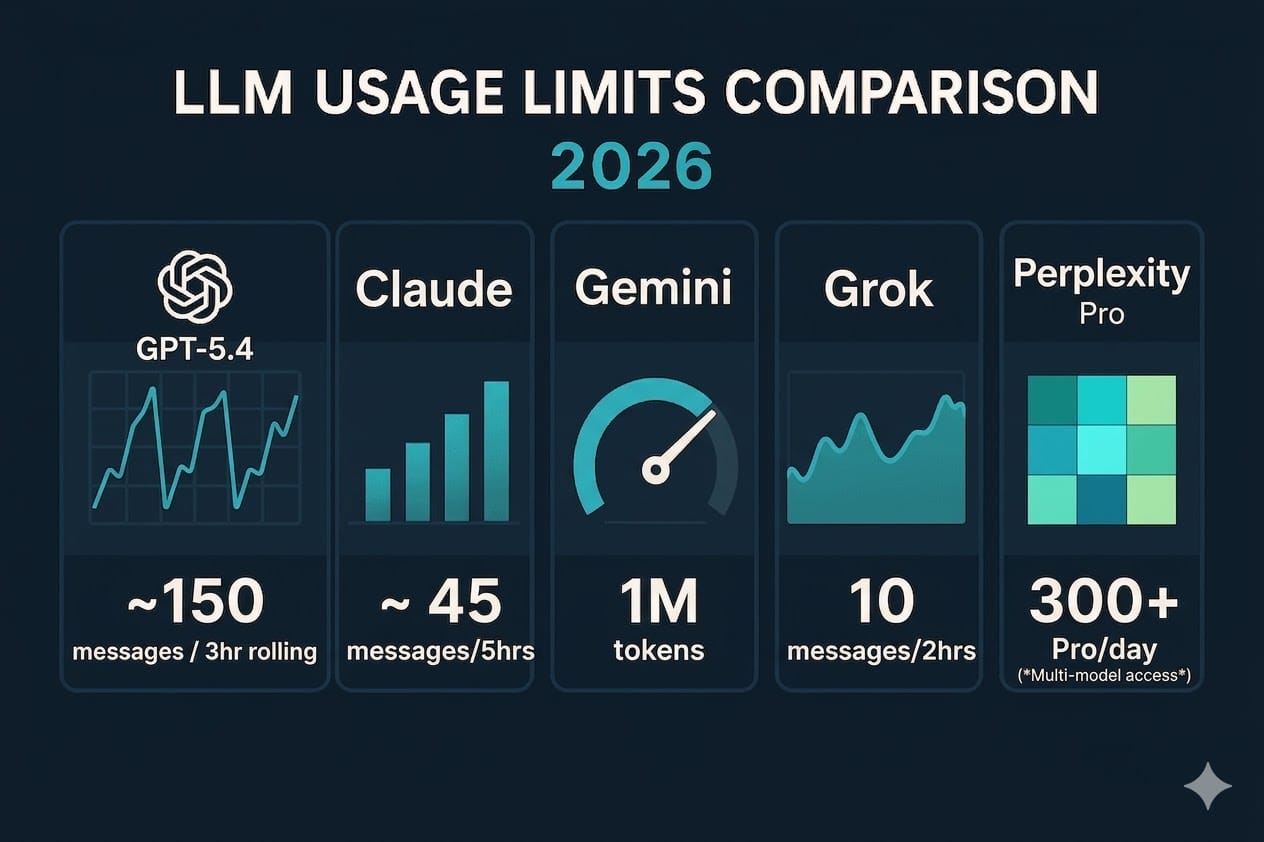
Rolling windows vs. daily caps. ChatGPT uses rolling time windows — usage resets per hour or per day, not at midnight. Claude uses a 5-hour rolling window. Grok’s limits are not publicly documented. Gemini uses daily limits resetting at midnight Pacific. Perplexity tracks Pro Searches per day.
“Unlimited” means different things. No platform offers truly unlimited usage on any tier. “Unlimited” in practice means “high enough that most users won’t hit it” — still subject to abuse prevention, server load, and fair-use policies.
Context window vs. conversation limit. A large context window tells you how much fits in a single conversation. It says nothing about how many conversations you can have per day. These are different constraints, and confusion between them is common.
Peak-hour throttling is real. Claude, Gemini, and ChatGPT all experience degraded performance during high-demand windows. This is distinct from hitting your personal usage cap — it’s platform-wide load. If your heaviest work happens during US morning hours, building in flexibility helps.
The floor has risen across the board. Free tiers in 2026 are meaningfully better than free tiers in 2024. You can do real work for free on any of these platforms — the question is how much, and at what quality ceiling.
The Bottom Line
Start with what you do most. Agentic coding → Claude. Broad feature set and spreadsheet/finance integration → ChatGPT. Living inside Google’s tools → Gemini. Research and source verification → Perplexity. Real-time X data or massive context windows → Grok.
The $20/month tier is still the sweet spot for most people. ChatGPT Plus, Claude Pro, and Perplexity Pro all sit at $20. Gemini Pro is $19.99. For the majority of individuals, one of these four will handle what you need.
The $100/month tier is newly competitive. OpenAI Pro $100, Claude Max 5x, and Google AI Ultra (now $99.99) all land in the same bracket. If you’re regularly bumping into Plus/Pro limits, evaluate the $100 tier before jumping to $200.
Use more than one. Most serious AI users maintain 2-3 subscriptions. The cost of adding a second $20 tool is usually worth it compared to using the wrong tool for the job.
Key Takeaways
- GPT-5.5 Instant is now the default model for every ChatGPT user — free, Go, Plus, everyone
- Google AI Ultra dropped to $99.99/month at I/O 2026 — down from $249.99; a $200/month tier also exists
- Anthropic doubled the Max plan 5-hour rate limit in May 2026; Pro throttling (peak hours) unchanged
- Anthropic’s programmatic credit pool change goes live June 15 — affects automated workflows through third-party apps and the Agent SDK
- Grok 4.3 is now the default for all consumer plans; all legacy model strings redirect to it
- Gemini’s free tier no longer includes Pro-class models as of April 1; Gemini 3 Flash remains free
- Gemini 3.5 Flash launched May 19 — stronger than 3.1 Pro on coding at lower API cost
- Perplexity’s Comet browser is free for everyone on iOS, Android, Windows, and Mac
- DALL-E 2 and DALL-E 3 are retired; ChatGPT Images 2.0 is the current image model
- Gemini 2.0 Flash and Flash-Lite deprecate June 1 — migrate now if you’re building on either
Pricing and features verified May 29, 2026. This article is updated monthly. All figures are approximate — always verify current pricing on each platform’s official page before subscribing.
Related reading: