
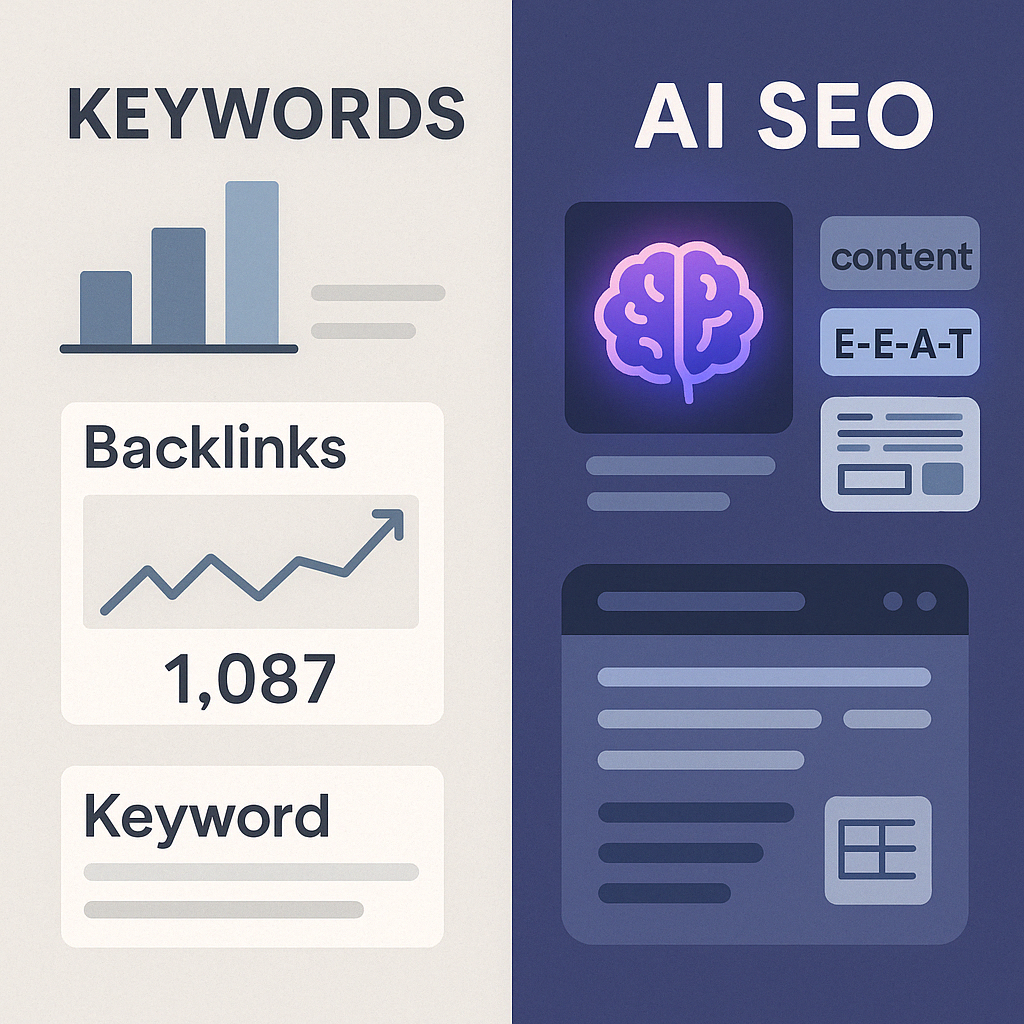
AI has fundamentally transformed how people find information online. Gone are the days when stuffing keywords into your blog post would guarantee visibility. In 2025, search engines don’t just find content—they understand it, summarize it, and often answer user questions without them ever clicking through to your site. For bloggers, this revolution requires a complete rethinking of SEO strategy. But here’s the good news: those who adapt can still thrive, and often with higher-quality traffic than before.
The Evolution of SEO
Traditional vs. AI-Era Optimization
| SEO Focus |
Traditional SEO (Pre-2023) |
AI-Era SEO (2025 and beyond) |
|---|---|---|
| Keyword Density | High importance | Natural usage + semantic relevance |
| Exact Match Keywords | Critical for ranking | Supportive, not critical |
| Backlink Quantity | More = better | Relevance & authority matter more |
| Click-Through Rate | Primary metric | De-prioritized with AI summaries |
| Content Approach | Evergreen only | Dynamic, updated frequently |
| SERP Rankings | Top goal | One of many metrics |
Key Insight:
In the AI era, the focus has shifted from technical optimization tricks to creating genuinely helpful content that demonstrates expertise and aligns with user intent.
How AI Has Completely Transformed What “SEO” Means
Remember when SEO simply meant researching keywords, placing them strategically throughout your content, and building as many backlinks as possible? Those days are history. Today’s AI-powered search engines like Google’s Search Generative Experience (SGE) and Bing AI operate more like intelligent assistants than simple matching algorithms.
These sophisticated systems now:
- Understand user intent beyond just keywords
- Synthesize information from multiple sources into direct answers
- Evaluate quality and expertise through advanced content analysis
- Personalize results based on individual user behavior
The most dramatic shift? Many searches now end right on the results page. A 2023 study found that when AI summaries appeared, organic click-through rates plummeted by nearly 70%, from roughly 2.94% to just 0.84%. This zero-click revolution means visibility no longer guarantees traffic.
Yet appearing as a source in these AI summaries still drives brand recognition and establishes your authority—even without the click. This means SEO success requires adapting to a dual goal: ranking well in traditional results while also optimizing to be featured in AI-generated content.
Why Your Old SEO Playbook Is Hurting You (And What Actually Works Now)
If you’re still following pre-2023 SEO advice, you might be actively harming your blog’s visibility. Here’s what no longer works—and what to do instead:
Outdated Tactics to Abandon Immediately:
- Keyword density targets: Forget the old 1-2% rule. Google’s algorithms now understand content like humans do. In fact, pages can rank for terms without using the exact keyword at all! One telling example: a page ranked #1 for “best automobiles” without ever using the word “automobile” (it used “cars” instead).
- Creating thin content for keyword variations: Publishing multiple short posts targeting slight keyword variations now signals low quality. Google’s “Helpful Content” system actively penalizes sites with unhelpful, thin content.
- Over-optimizing headings and meta tags: Having your exact keyword in every H2 and meta description looks manipulative to both readers and algorithms.
- Focusing on word count alone: Length doesn’t equal quality. AI can detect fluff and filler content that adds words without value.
What Actually Works in 2025:
- Demonstrating E-E-A-T: Showing Experience, Expertise, Authoritativeness, and Trustworthiness through quality content, appropriate citations, and clear author credentials.
- Topic authority: Covering subjects comprehensively across multiple connected posts to establish your site as a valuable resource.
- User experience signals: Fast load times, mobile optimization, and content that keeps readers engaged send powerful quality signals.
- Structured data: Implementing schema markup to help AI understand your content format (articles, FAQs, how-tos) and potentially feature it in rich results.
The central shift is this: where SEO once focused on manipulating algorithms, it now rewards genuinely helpful content created with real expertise. As one industry expert bluntly puts it, “the old SEO playbook just isn’t working anymore.”
The E-E-A-T Framework for AI-Era SEO
How to Demonstrate Expertise, Experience, Authoritativeness, and Trustworthiness
| E-E-A-T Element | Key Requirements | Implementation Strategies |
|---|---|---|
| Experience | First-hand expertise with the topic | Share personal stories, case studies, examples of direct application |
| Expertise | Deep knowledge and skills in the subject | Provide data-backed insights, advanced explanations, current research citations |
| Authoritativeness | Recognition as a trusted source | Showcase credentials, industry recognition, external validation, quality backlinks |
| Trustworthiness | Accuracy, transparency, and responsibility | Cite sources, provide balanced viewpoints, update content regularly, disclose conflicts |
Key Insight:
AI algorithms increasingly evaluate content based on how well it demonstrates E-E-A-T factors rather than traditional SEO metrics. Content that shows genuine expertise and first-hand experience now outperforms technically optimized but superficial content.
The Exact Content Structure AI Search Engines Reward in 2025
AI search engines analyze your blog’s structure to determine quality and relevance. Here’s how to organize content for maximum visibility:
Optimal Blog Structure for AI Search Engines
How to Format Content for Both Human Readers and AI Algorithms
| Content Element | Traditional Approach | AI-Optimized Approach |
|---|---|---|
| Title Structure | Keyword-focused, often clickbait | Question-focused, conversational, direct answer to user intent |
| Introduction | Drawn out, keyword heavy | Immediate value proposition, direct answer summary first |
| Headings (H2, H3) | Primarily for keyword placement | Structured as complete questions users actually ask |
| Content Blocks | Long paragraphs, limited formatting | Short paragraphs, bulleted lists, tables, infographics |
| Internal Linking | Random, keyword-driven anchors | Topic clustering, semantic relevance, clear context |
| Schema Markup | Minimal or none | Rich, detailed structured data for AI understanding |
Key Insight:
AI search engines now prioritize content that’s structured to answer specific user questions efficiently. The optimal blog post structure creates a clear information hierarchy that both human readers and AI systems can easily navigate, extract, and summarize.
Title and Introduction
- Clear, descriptive title (H1) with your primary keyword naturally included
- Front-loaded information in your introduction that mentions your topic in the first 100 words
- Concise preview of what readers will learn to immediately confirm relevance
Logical Hierarchy of Headings
- Descriptive H2s for each major section (include relevant keywords where natural)
- Supportive H3s for subsections that further break down complex topics
- Question-based headings for topics that might appear in “People Also Ask” sections
Formatting for Readability and AI Parsing
- Short paragraphs (2-4 sentences maximum)
- Bullet points and numbered lists for steps, tips, or multiple related items
- Bold text for key concepts or important points within paragraphs
- Tables for comparisons that AI can easily extract for featured snippets
Strategic Content Components
- FAQ section with schema markup for common questions
- Definitions of key terms that might trigger featured snippets
- Concise summaries at the end of sections or the entire post
- Well-labeled images with descriptive alt text (include relevant keywords if natural)
Remember: Google and Bing may use your headings to jump users to specific parts of your content, and featured snippets frequently draw from well-structured sections. By organizing your blog with logical sections and clear formatting, you help both human readers and AI systems navigate your content effectively.
7 Actionable Steps to Optimize Your Blog Posts for AI Search
Ready to implement AI-friendly SEO on your blog? Here’s your step-by-step process:
1. Research User Intent Beyond Keywords
Before writing, understand exactly what question or need your post will address. Tools like AnswerThePublic and AlsoAsked reveal what people actually ask about your topic. For example, if targeting “AI document creation,” you might discover related questions like “Is AI document creation secure?” that you should address.
2. Craft Compelling Titles and Introductions
Your title should include your primary keyword naturally while being attention-grabbing. For example, rather than “AI Document Creation Guide,” try “How AI is Transforming Business Document Creation in 2025.” Then ensure your introduction clearly establishes your topic in the first paragraph.
3. Build Comprehensive Content That Demonstrates Expertise
Go beyond surface-level information. Include:
- Brief history or background
- Pros and cons
- Step-by-step explanations
- Examples or case studies
- Statistics or data when available
- Your unique insights from experience
This demonstrates the expertise that AI summaries prefer to source from, while providing deeper value than what appears in zero-click results.
4. Optimize for Featured Snippets and AI Summaries
Create “snippet bait” by directly answering common questions in a single paragraph. For “how to” content, use numbered lists that AI can easily extract. For definitions, start sentences with phrases like “AI-powered SEO is…” to create clear definition blocks.
5. Develop Content Clusters for Topical Authority
Rather than one-off posts, create interconnected content around core topics. For example, if your focus is “AI for bloggers,” develop related posts about AI writing tools, AI SEO analysis, AI research methods, and link them together. This signals to search engines that you’re an authority on the broader topic.
6. Balance Technical SEO with Readability
Implement proper schema markup and structured data, but never at the expense of natural writing. Use plugins like Yoast SEO or Rank Math as guides, not strict rulebooks. If a plugin suggests awkward keyword placement that hurts readability, prioritize the reader experience.
7. Measure Success Beyond Traditional Metrics
Don’t just track rankings and click-through rates. Monitor:
- Brand mentions and citations in AI summaries
- Featured snippet appearances
- “People Also Ask” inclusions
- Engagement metrics (time on page, scroll depth)
- Conversion rates from visitors who do click through
These metrics better reflect success in the era of AI search.
The Tools Smart Bloggers Are Using to Master AI SEO
You don’t need expensive software to implement modern SEO. These free or affordable tools can help:
Keyword and Topic Research
- Google Keyword Planner: Validate search volume for potential topics
- AnswerThePublic: Discover questions people ask about your topic
- AlsoAsked: Identify related questions from “People Also Ask” sections
- ChatGPT/Claude: Generate content ideas and keyword variations
Content Optimization
- Yoast SEO/Rank Math: WordPress plugins for basic on-page optimization
- Grammarly/Hemingway Editor: Improve readability and clarity
- Google Search Console: Track which queries bring visitors and how they engage
- Schema Markup Validator: Ensure your structured data is implemented correctly
AI Search Monitoring
- Bing Chat: Research how AI might summarize topics in your niche
- Google’s SGE (if available via Search Labs): See what information Google’s AI compiles for relevant queries
When using these tools, remember that they’re guides, not gospel. The most important “tool” remains your understanding of your audience and subject matter expertise.
Beyond Optimization: Creating Content That Transcends AI Summaries
While adapting to AI search is crucial, don’t lose sight of what makes your content valuable beyond what an AI can summarize. The most successful bloggers in 2025 create content that offers:
- Original insights and analysis that can’t be easily compiled from other sources
- Personal experiences and case studies that demonstrate real-world expertise
- Distinctive voice and perspective that builds reader connection
- Visual assets and multimedia that enhance understanding in ways AI summaries can’t capture
Remember: If your entire value can be distilled into a two-sentence AI summary, you need more unique value in your content.
The Future of Blogging in an AI-Powered World
The integration of AI into search hasn’t diminished the importance of blogs—it’s simply raised the quality bar and changed how audiences discover content. By creating genuinely valuable resources that demonstrate expertise and are structured for both human readers and AI systems, bloggers can continue to build authority and engage audiences.
The key is adapting to this new ecosystem rather than fighting against it. Embrace AI as a tool in your workflow, understand how it influences content discovery, and focus on creating resources that go beyond what AI can summarize or generate on its own.
In this new era, success belongs to bloggers who combine technical optimization with authentic expertise and audience connection. The future of blogging isn’t just about being found—it’s about being worth finding.