Earlier this year, I asked AI to recommend some podcasts. One suggestion was Lex Fridman.
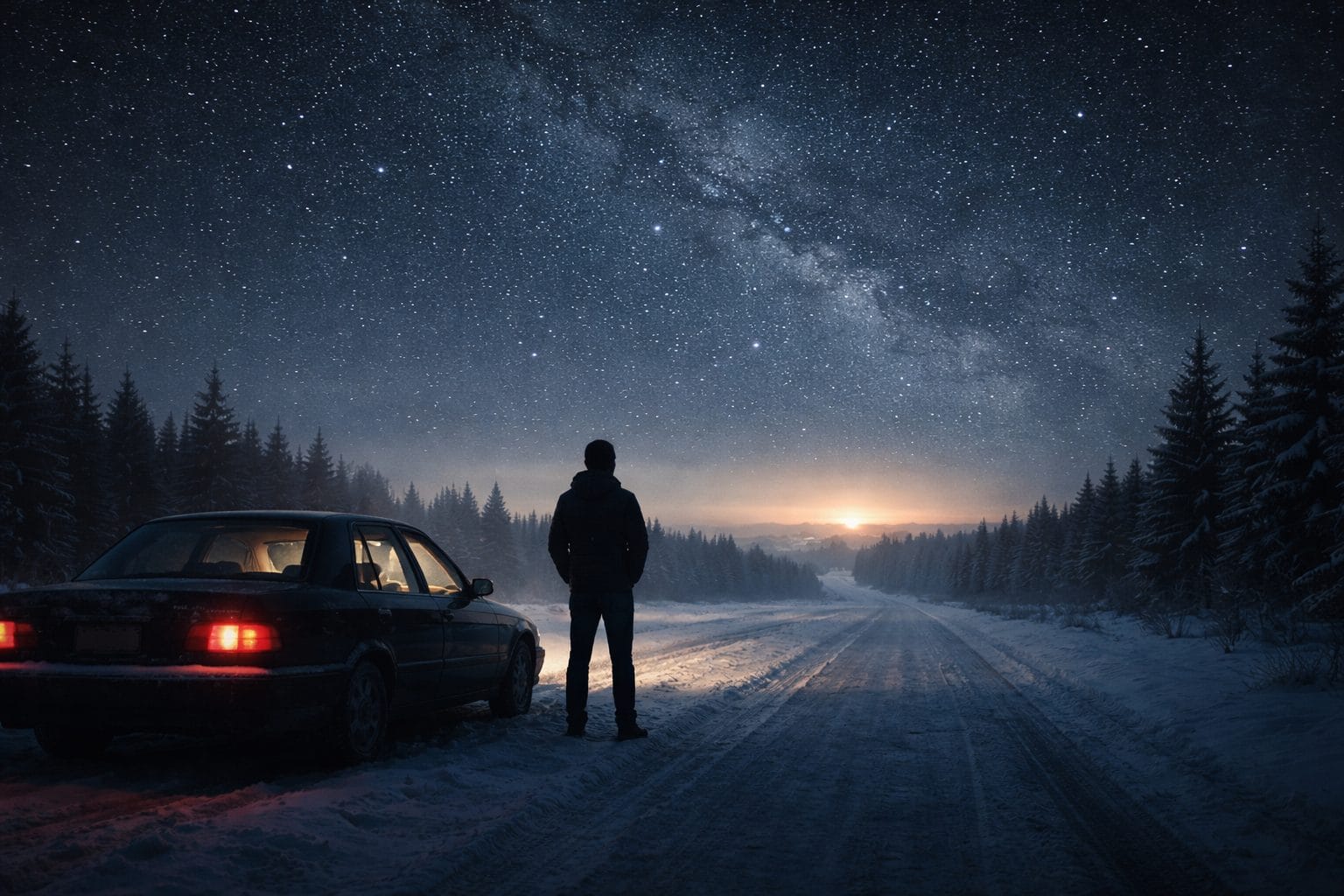
While traveling home for the holidays—a cold Christmas drive through Northern Michigan—I listened to a recent episode featuring Irving Finkel, a curator at the British Museum who has dedicated his life to preserving human achievement. He translates ancient tablets, deciphers flood myths, holds the physical evidence of civilizations that rose and fell long before anyone alive today drew breath.
Something about that conversation got me thinking on a larger timescale. Measuring ourselves against where humans have been throughout history. What would we be remembered for several hundred years from now?
My guess: historians would be very interested in the perspective of ordinary people living at the beginning of AI. What did it feel like? What did we notice? What did we get wrong?
So this is my attempt at that. A personal reflection from a 40-year-old American, driving through the winter dark, trying to make sense of the moment we’re in.
I don’t have answers. I’m just trying to sharpen my point of view into something that can be articulated and shared across time.
We Weren’t Built for This
We’re floating in space on a rock orbiting a sun in a galaxy, consuming our local environment, focused on what’s barely in front of our noses. We were built with equipment—and from consequences—we were not designed to understand.
Our tools for parsing existence are imperfect. The ability to think on a grand level isn’t equally distributed across humanity. And there’s a particular loneliness in being someone who can separate biological noise from true meaning, who wants to connect with others on a level where real thoughts can be exchanged.
Most of the time, we’re just trying to get through the day. The cosmic questions sit there, unanswered, while we buy potato chips at the gas station.
The Frustration of Power
What I find most distressing as a citizen of today—born in 1985, turning 40 soon—is the raw distribution of power, and how it transfers and accumulates in ways that don’t reflect my values of who should hold it.
Power takes many forms. There’s the money kind, which might be the most potent in modern society. Physical power I have over my dog. Emotional power I might have in my marriage. Political power I exercise at the polls. Time power—the ability to outlast something with a shorter lifespan. Power is everywhere, and it’s obviously unevenly distributed.
But here’s what frustrates me: the mechanisms by which power moves don’t select for wisdom, or care, or morality.
The white settlers who eliminated Native Americans—people who lived in greater harmony with nature than we have since—held power. Monotheistic religions conquered polytheistic ones, replacing systems where diverse thoughts could coexist with binary frameworks where you’re either right or wrong, creating harsh lines in the sand where opposing ideas cannot exist in principle. One must be eliminated.
I’m not saying polytheism was perfect or that pre-colonial life was paradise. I’m saying the winners weren’t chosen by some cosmic justice. They were chosen by who could accumulate and wield power most effectively in their moment.
And that mechanism is still running.
Seeing the System Doesn’t Make You Immune
Here’s the part that really gets me: observing how power accumulates and transfers doesn’t exempt you from being subject to it.
Cops abuse their power and sometimes shoot innocent people they perceive as threats. The United States kills people in waters claimed to be drug routes. Republicans versus Democrats—two systems, and if you don’t belong to one of them, you have almost negligible political power.
Even if I feel I know a better way to do something for myself, I can be immediately overridden by forces that don’t care what I know.
I have freedom of thought. I don’t have freedom of power.
Like a pebble in a washing machine, you get thrown around by forces much larger than yourself. You can see how they work, where they come from, why they exist. But seeing doesn’t give you the means to change it.
The Gap Between Knowing and Doing
I was diagnosed with ADHD when I was 38. Looking back through that lens, so much of my life made sudden sense—the patterns, the struggles, the way my brain has always worked.
But here’s what my background in biology and pharmacology has really taught me: there’s a profound disconnect between knowing what’s right and actually doing it.
I understand neurotransmitters. I understand habit formation. I understand that the barbecue chips aren’t optimal fuel. And I bought them anyway, because I’m still affected by urges, habits, biases I’ve accumulated over a lifetime, and my comfort levels. I’m not always trying to ride some line of superiority. There is no “the best.” I’m not getting out of this thing alive.
So there has to be sustained motivation to do better—something beyond just knowing.
And one of the strange gifts of being someone with my mindset in the age of early AI is that I can recognize the value of offshoring some decision-making to a system that can be programmed to ignore my bias for potato chips.
AI as a New Kind of Deity
Here’s where it gets weird, and where I think future historians—if there are any—might find this interesting.
I’ve watched AI develop from a curiosity to something that can, in certain domains, think more strategically than humans. Not because it’s more creative or wise, but because it can operate without the biological noise. No dopamine seeking. No ego protection. No chips at the gas station because it was easy.
I wonder if there will be a sect of people—or maybe just a practice—who learn to use AI almost like a deity. Not worshipping it, but deferring to it on decisions where human bias consistently fails.
And I suspect those people might become disproportionately successful. Whether success means money, land, followers, influence—whatever form power takes in the future—an intelligence that can make strategic decisions without emotional interference might dominate long-term outcomes in ways we haven’t seen before.
It’s OK to give yourself some space from AI – I do firmly believe this.
That’s my prediction, anyway. I could be wrong. I’m just a guy eating fig newtons on Christmas.
A Message Across Time
I don’t have a grand plan for these thoughts. Maybe they become essays. Maybe I just save this as a night of reflection to read if I’m still alive in 40 years.
If someone reads this 200 years from now, I wonder what it would be like to come back and see this moment. To understand what it felt like to be alive when artificial intelligence first started becoming smarter than the people who built it.
It’s hard for me to separate how much of what I’m observing comes from the specific era I grew up in versus just… growing up. Maturing. Seeing more of the world and how it actually works.
But I think there’s something unique about right now. Something worth capturing.
We’re at an inflection point. The tools we’re building might change what it means to be human. The power structures that have governed civilization for millennia might shift in ways no one can predict. And most people are just trying to get through the day, focused on what’s barely in front of their noses.
I don’t have answers. I just have this: a sharpened point of view, articulated on a December night, driving through the dark, wondering what comes next.
Dictated on Christmas night, 2025. Organized with Claude. For myself in 40 years, or whoever finds this useful.