Yes, you can often sell AI-generated images and use AI writing commercially. The answer for your particular print, blog illustration, book cover, or client project depends on the tool’s terms, the material involved, and where you’re using it.
The distinction that matters early: permission to sell an image and the ability to stop someone else copying it are separate things. A provider’s ownership clause describes your relationship with that company. Copyright protection depends on the law and how the work was created. OpenAI — Terms of Use; U.S. Copyright Office — Copyright and Artificial Intelligence, Part 2: Copyrightability.
This guide focuses on U.S. rules for images and writing, with UK and EU differences below. It provides general information to help you identify what to check; it isn’t a legal opinion on a particular asset. Sources checked September 13, 2026.
Start with what you’re making
Use these examples to find the checks that deserve the most attention. They are starting points for review, not individual legal clearances.
| Your project | Start here |
|---|---|
| An illustration for a blog that earns money | Check commercial-use terms and review the image for other people’s protected material. |
| A print, T-shirt, or digital download | Check the selling platform’s AI rules and decide how much your business depends on exclusivity. |
| A book cover or illustrated book | Check the publishing platform’s declaration requirements, including AI images inside the book. |
| An article or marketing copy for a client | Read the agreement for AI restrictions, confidentiality and promises about originality or rights. |
| A business logo | Consider copyright and trademark separately before promising exclusive rights. |
For each project, work through the same five checks.
1. Check the terms for the tool you actually used
Open the terms that apply to your product and account. Look for commercial use, output ownership, third-party rights, and any feature-specific restrictions. Save the relevant terms with your project.
A subscription price alone won’t answer those questions. Here are examples of what the official pages actually say:
| Tool | The useful detail to check |
|---|---|
| ChatGPT | OpenAI’s terms assign its rights, if any, in output to you, within applicable law. They also warn that outputs can be similar to those other people receive. Terms of Use |
| Gemini / Google | Google’s general terms say it won’t claim ownership of original content generated through its services. Check the additional terms for the particular service and account you’re using. Google Terms of Service |
| Adobe Firefly | Adobe permits commercial use of outputs from features without a beta label. Beta outputs can also be used commercially unless the product explicitly says otherwise. Adobe Firefly FAQ |
| Midjourney | Its ownership provision is subject to applicable law and third-party rights. Companies, or employees of companies, with more than $1 million in annual revenue need Pro or Mega under that provision. Public content is also viewable and remixable by default. Terms of Service |
| Canva | Its AI terms permit lawful use of outputs, subject to the terms. Outputs incorporating Canva library content remain subject to that content’s license; generating or editing a design doesn’t give you ownership of its stock photos. AI Product Terms |
Apply these clauses to the actual file you plan to use. For a Canva download, for instance, your generated illustration and the library photo beside it can have different rights attached.
2. Check what went in—and what came out
An image can look original at first glance and still contain somebody else’s character, artwork, or branding. Review the actual output before uploading it to a shop or sending it to a client.
Pay particular attention to:
- Reference photos, illustrations, and articles you uploaded.
- Recognizable characters, logos, or close copies of an existing work in the result.
- Real people’s likenesses, particularly in advertising.
- Names or descriptions that suggest someone endorsed or created the work.
For uploaded material, establish your basis for using it: your own rights, an appropriate license or permission, public-domain status, or an applicable legal exception. A photo being publicly visible online doesn’t settle that question. U.S. fair use requires considering the specific circumstances; commercial use is a factor, but doesn’t automatically decide the outcome. U.S. Copyright Office — U.S. Copyright Office Fair Use Index.
A request for work “in the style of” a living artist needs care too. Artistic style by itself isn’t separately protected by copyright, but copying protected expression or exploiting someone’s identity can raise other issues. As a practical choice, describe the visual qualities you want—loose brushwork, muted colors, geometric shapes—and avoid marketing the result as connected to an artist who wasn’t involved. U.S. Copyright Office — Copyright and Artificial Intelligence, Part 1: Digital Replicas.
Adding an AI label or crediting an artist supplies information. It doesn’t supply permission to use their work. When recognizable protected material is central to something you plan to sell, resolve the rights question before committing to the product.
3. Check the rules where you’ll sell or publish
The marketplace makes its own acceptance rules. An AI tool letting you create a file doesn’t tell you whether a particular shop or publishing service will accept it.
Etsy: disclose AI use in the listing description
Etsy allows seller-prompted AI creations within its “designed by a seller” category. Its standards require disclosure in the listing description when an item is created with AI. AI prompt bundles don’t qualify under that category. Etsy — Etsy’s Creativity Standards.
For a print you generated and then prepared for sale, a straightforward description could say: “Created using generative AI, then edited and prepared for print.” Only describe the editing if you actually did it. Also check any production-partner requirements that apply to how the item is made. For the creation and fulfillment steps, see How to Use AI to Make a Print-on-Demand Product: The Complete Step-by-Step Process.
Amazon KDP: editing a generation doesn’t erase the declaration
KDP requires you to inform Amazon about AI-generated text, images, or translations when publishing a new book or editing and republishing an existing one. That includes cover and interior artwork.
Its distinction is specific: content created by an AI tool remains AI-generated for this policy even after substantial edits. Content you created yourself, with AI used to refine it or help brainstorm, can count as AI-assisted and doesn’t require that declaration. Amazon KDP — Content Guidelines.
So a book you’ve written yourself can still need an AI-generated-content declaration because of its cover. Treat the text and images separately when reviewing your workflow. The guide to publishing a nonfiction book on Amazon KDP covers the broader publishing process.
Adobe Stock: check submission rights as well as labels
Adobe Stock requires the relevant generative-AI labeling and the rights necessary to license the content. Its guidelines also restrict prompts, titles, and keywords referring to artists, real people, fictional characters, and third-party intellectual property. Check its model/property release rules and fictional-person/property checkbox where relevant. Adobe Stock — Generative AI content guidelines.
A tool’s permission to use an image in your own marketing shouldn’t be treated as proof that you can submit it for stock licensing. Check that intended use explicitly.
4. Check what you’re promising clients and buyers
Before using AI for a client, read what you agreed to deliver. Look for terms about AI use, human authorship, originality, confidentiality, and exclusive rights.
For an ordinary copywriting assignment, a useful conversation is specific: which parts will use AI, what you’ll write or edit yourself, what information can enter the tool, and what rights you’re promising in the finished work. Record that understanding in the agreement. This is a practical way to prevent a mismatch between your process and the client’s expectations.
For confidential source material, get the client’s requirements clear before uploading it. Check the actual service’s data handling and your organization’s approved tools. Treating “paid” or “enterprise” as a complete answer skips the details that matter.
Buyers also need an accurate picture of what they’re getting. As an editorial practice, use real product evidence for claims about appearance, features, or results. If an AI mockup shows a finish or accessory that isn’t included, fix the image and description.
Fake customer experiences are a clearer boundary. The FTC’s rule covers fake or false reviews and testimonials, including prohibited uses involving AI. Its guidance also says AI avatars aren’t universally banned: what matters includes whether the underlying testimonial is fake and whether the presentation deceives consumers. FTC — The Consumer Reviews and Testimonials Rule: Questions and Answers.
Don’t turn “AI-generated” into a small-print excuse for a customer story that never happened.
5. Decide what protection you need
For a decorative blog illustration, exclusivity might have little practical value to you. For the main design in a product line, it can matter much more.
Under the U.S. Copyright Office’s approach, purely AI-generated material isn’t protected by copyright. Human-authored expression, creative modifications, or sufficiently creative selection and arrangement can be protected. Prompts alone generally don’t establish authorship of the resulting output with current systems. There is no percentage-edited shortcut. U.S. Copyright Office — Copyright and Artificial Intelligence, Part 2: Copyrightability.
Keep your drafts, original outputs, layered files, and final versions. They help show what you contributed. If you apply for U.S. copyright registration, follow the Copyright Office’s instructions for identifying human authorship and excluding more than minimal AI-generated material from the claim. U.S. Copyright Office — Copyright Registration Guidance: Works Containing Material Generated by Artificial Intelligence.
Give business logos a separate review
Copyright and trademark protect different things. Trademark concerns a sign identifying the source of goods or services; copyright concerns qualifying creative expression. A logo’s lack of copyright protection doesn’t, by itself, decide whether it can function as a trademark. USPTO — Trademark, patent, or copyright.
Before offering a logo as an exclusive brand asset, arrange a trademark clearance review and establish what rights you can actually provide. Hiring a human designer doesn’t replace that clearance step either.
For a print or illustration, the practical question is whether your plan still works if you have limited copyright protection in the generated elements. Make that decision before building the offer around exclusivity.
UK and EU readers need an additional check
The U.S. authorship position isn’t a universal rule. The UK has a specific provision for computer-generated works. The government’s March 2026 report discusses uncertainty around it and proposes removal in the absence of evidence of its ongoing value. A proposal to remove protection is different from an enacted repeal. UK Government — Report on Copyright and Artificial Intelligence.
In the EU, the AI Act’s transparency requirements apply from August 2, 2026, with duties depending on your role and use. Article 50 distinguishes providers’ technical marking duties from users’ disclosure duties for deepfakes and certain public-interest text. It includes an exception for that text where human review or editorial control occurs and someone holds editorial responsibility. Check the applicable provision before deciding how to label your content. European Commission — AI Act; Article 50: Transparency obligations for providers and deployers of certain AI systems.
Before you sell AI content: five checks
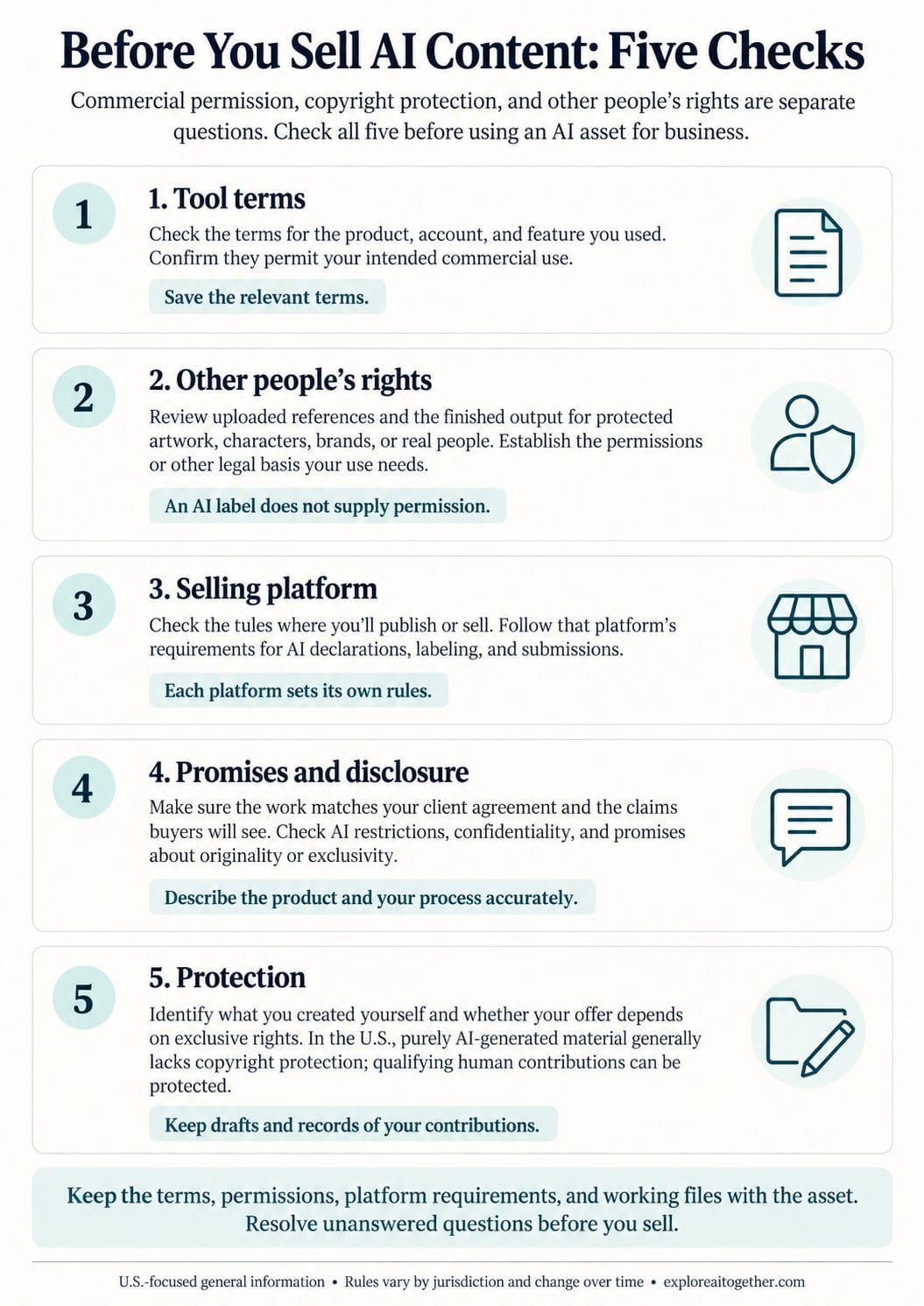
Keep a short note with the asset:
- Tool terms: Which product, account, and terms permit the intended use?
- Other people’s rights: What did you upload, what appears in the output, and what permissions or other legal basis support that use?
- Selling channel: What does this platform require for this item, including AI declarations?
- Promises and disclosure: Does the deliverable match the client agreement and the claims buyers will see?
- Protection: What did you create yourself, and does the offer depend on exclusive rights you haven’t established?
Attach the relevant terms, permissions, and working files. If an answer is unresolved, identify the specific action: check a license, revise the image, agree a contract term, or get advice on the proposed use.
That gives you something more useful than a general “AI is allowed” answer: a reason for using this asset in this project.